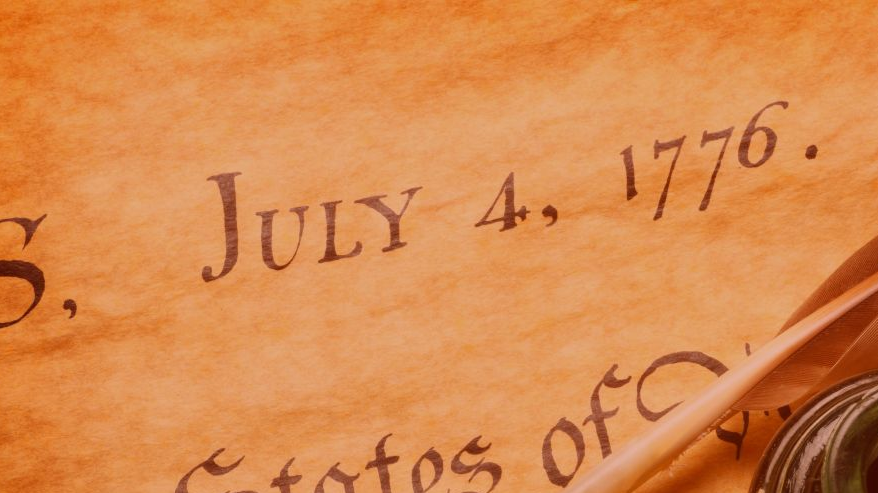
On its 249th anniversary, the Declaration of Independence—a document once held as sacred by nearly all Americans—now serves as a flashpoint in the nation’s culture wars.
Today, there are two Americas. One sees the Declaration as a timeless expression of universal truths: liberty, natural rights, and government by consent. The other views it as a hypocritical relic—useful only to highlight how far short the country has fallen from its ideals.
On one side are modern patriots, many of them working- and middle-class Americans, who love their country even while recognizing its flaws. They acknowledge past injustices but believe in the promise of the American experiment. These are people who still find meaning in July 4th and the founding documents. Unsurprisingly, most of them support President Donald Trump.
On the other side are America’s elites—academics, media figures, and corporate influencers—who feel little personal grievance toward the nation but nevertheless harbor deep resentment. They view the country through the lens of oppression and inequality, and many sneer at the founding as little more than a smoke screen for power and exploitation. Most of them loathe Trump and his base.
At the core of this divide is a fundamental disagreement about what the Declaration of Independence stands for—and whether America ever lived up to its ideals.
Those who honor the Declaration tend to take its commitment to equality seriously. They reject policies that divide Americans into competing identity groups. They want opportunity based on merit and character, not skin color or ancestry.
Meanwhile, those who dismiss the Declaration have no problem reducing people to categories—white, black, male, female—and demanding government policy be based entirely on group identity. In their eyes, the country’s founding was fatally flawed and must be dismantled or reinterpreted to correct it.
This clash isn’t new. It echoes debates from the 19th century, when Americans were also split over the meaning of the Declaration. Two speeches—one by abolitionist Frederick Douglass and the other by Confederate Vice President Alexander Stephens—offer a chilling reminder that how we interpret the Founding can shape the soul of the nation.
Frederick Douglass: A Slave Who Saw the Promise
In 1852, Douglass—born into slavery, brutalized by it, and denied his family—had every reason to reject the Declaration of Independence as a fraud. Instead, he stood before an audience and called it “the ringbolt to the chain of your nation’s destiny.”
“The principles contained in that instrument are saving principles,” Douglass declared. “Stand by those principles, be true to them on all occasions, in all places, against all foes, and at whatever cost.”
He honored the Founders as brave men, not perfect, but remarkable for the truths they risked their lives to declare. He didn’t dismiss their legacy—he challenged America to live up to it.
Even the Constitution, often attacked by modern critics as a pro-slavery document, was, in Douglass’s view, “a glorious liberty document”—a tool to abolish slavery, not defend it.
Alexander Stephens: The Declaration Is Wrong
Contrast that with Alexander Stephens, who in 1861 praised the Confederacy for doing what he claimed the Founders failed to do—reject equality.
Stephens admitted Jefferson and the Founders believed slavery violated natural law and hoped it would one day vanish. But he rejected their philosophy outright.
“Those ideas… were fundamentally wrong,” he said. “Our new government is founded upon exactly the opposite idea; its corner-stone rests upon the great truth that the negro is not equal to the white man.”
Stephens twisted the Founders’ work into a justification for permanent racial subjugation. His speech revealed a deeply chilling belief: not that America failed to live up to the Declaration, but that the Declaration itself was the mistake.
What This Means Today
Nearly 250 years after its signing, the Declaration of Independence is still the dividing line in our national identity.
Like Douglass, today’s patriots love their country not because it’s perfect—but because it aspires to something greater. They believe America is still worth fighting for. They see July 4th as a reminder of that promise.
Those like Stephens—whose ideas still echo today in academic theories and grievance politics—reject that promise. They believe America was wrong from the start. They seek to tear down, not redeem.
And that’s why so many Americans today hate their own country: they’ve been taught to see its founding not as a triumph of liberty, but as a cleverly disguised crime scene.
Ultimately, it comes down to this: Are we the heirs of Frederick Douglass—or of Alexander Stephens?
The answer to that question will shape the next 249 years.