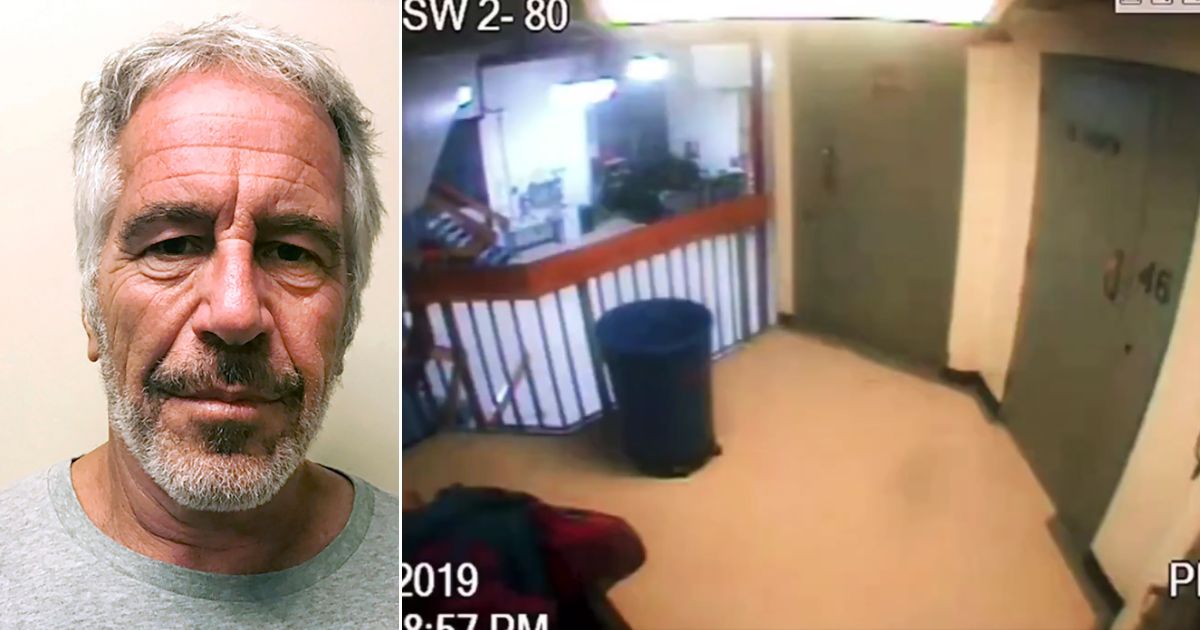
A recent forensic analysis of surveillance footage from the prison where Jeffrey Epstein died has revealed that the so-called “raw” video released to the public was, in fact, modified—though experts say there’s no clear evidence it was deliberately manipulated with deceptive intent.
The revelation comes just days after the Department of Justice issued a bombshell statement declaring that no “client list” exists among the Epstein investigation documents, contradicting months of speculation and political pressure.
In an attempt to address persistent rumors that Epstein was murdered, not suicidal, the DOJ released video footage from the night of his death, claiming it showed no one entered his cell from the time it was locked until his lifeless body was discovered the next morning.
As part of its statement, the department admitted the FBI had enhanced the footage prior to public release by “increasing its contrast, balancing the color, and improving its sharpness for greater clarity and viewability.” The DOJ insisted that both the “raw” and “enhanced” versions of the video were now publicly accessible on its website.
However, an investigation by Wired found that the footage was not as unaltered as advertised. Working with independent video forensics experts, the tech outlet discovered that the video’s metadata suggests it was processed and modified—casting fresh doubt on the DOJ’s transparency and potentially reigniting conspiracy theories rather than putting them to rest.
Metadata Tells a Different Story
According to Wired, metadata embedded in the video files revealed that the version labeled “raw” was not exported directly from the prison’s internal surveillance system. Instead, it appeared to be compiled from at least two separate source clips and processed through professional video editing software—likely Adobe Premiere Pro.
The metadata also revealed that the file was saved four times over a 23-minute span on May 23, raising questions about what occurred between those saves. Experts cautioned that while this does not conclusively prove foul play, it indicates the footage was not untouched.
“The video may have simply been stitched together or optimized for public viewing,” Wired reported, “but the fact that it was billed as ‘raw’ when it clearly was not, opens the door to renewed skepticism.”
Digital forensics professor Hany Farid of UC Berkeley, an expert in video authenticity and misinformation, told Wired that such inconsistencies would not meet legal standards.
“If a lawyer brought me this file and asked if it was suitable for court, I’d say no. Go back to the source. Do it right,” said Farid. “Do a direct export from the original system—no monkey business.”
Farid also questioned changes in the video’s aspect ratio and said these technical alterations, while not necessarily malicious, create unnecessary doubt.
DOJ Explanation Leaves Gaps
One particularly troubling issue is a missing minute of footage—something Attorney General Pam Bondi attributed to the age and limitations of the Bureau of Prisons’ surveillance system.
Speaking to Newsweek, Bondi explained that the prison’s camera system, installed in the late 1990s, resets its recordings nightly, and that the same missing minute occurs every night. She claimed the DOJ was working to release footage from additional nights to demonstrate the consistency of this technical flaw.
“What we learned from the Bureau of Prisons is that every night, they redo that video,” Bondi said. “It’s old, from, like, 1999. Every night, the video is reset. Every night should have the same minute missing.”
Still, for many in the public—and particularly among Trump’s base—those explanations are not enough.
Political Fallout Continues
The DOJ’s announcement about the nonexistence of a “client list,” paired with questions about the video’s authenticity, has only deepened frustration among conservatives who expected full transparency and revelatory disclosures from the Epstein investigation.
The handling of the case has even sparked internal tensions within the Trump administration. Attorney General Bondi and FBI Deputy Director Dan Bongino reportedly had a heated exchange at the White House, following a NewsNation report that suggested the FBI would have released the Epstein files months ago if not blocked by the DOJ—a claim that Bondi and other officials have denied, but Bongino did not directly refute.
Political observers say the Epstein saga has now transformed from a criminal investigation into a test of credibility for Trump’s justice team—and a lightning rod for conspiracy-driven backlash on the right.
As calls grow louder for more clarity and true raw footage, digital experts like Farid caution that only a full, transparent chain-of-custody process will satisfy skeptics and restore trust.