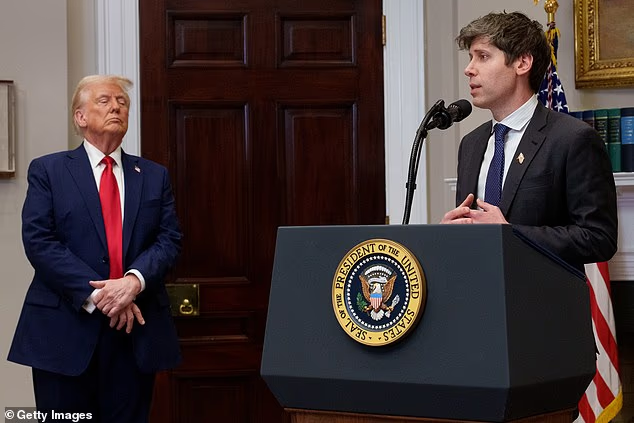
In a stunning Independence Day declaration sure to send shockwaves through Democratic circles, Sam Altman, CEO of OpenAI and co-founder of the company behind ChatGPT, publicly distanced himself from the Democratic Party, accusing it of abandoning its core principles.
Altman, one of the most powerful tech figures on the planet and a longtime backer of liberal causes, took to X (formerly Twitter) over the holiday weekend with a scathing post outlining his disillusionment.
“The Democratic Party seemed reasonably aligned with [my views] when I was 20,” Altman wrote. “It lost the plot when I was 30, and has completely moved somewhere else at this point. So now I am politically homeless. But that’s fine — I care much more about being American than about any political party.”
The billionaire — who came out as gay at 16 and has often positioned himself as a progressive innovator — began his thread by expressing pride in being a U.S. citizen. But the post quickly shifted toward a critique of what he sees as the party’s descent into identity-driven, anti-capitalist rhetoric.
“We should encourage people to make a ton of money,” Altman said. “I’d rather hear from candidates about how they are going to make everyone have the stuff billionaires have instead of how they are going to eliminate billionaires.”
With an estimated net worth of $1.7 billion and unprecedented influence in the field of artificial intelligence, Altman’s defection from the Democrats is more than symbolic. As the head of OpenAI, he’s at the helm of a technological revolution poised to reshape economies, governments, and global power.
Altman’s sharp critique is just the latest escalation in a broader ideological shift among Silicon Valley elites, many of whom have grown frustrated with what they perceive as the Democratic Party’s drift toward economic populism and regulatory overreach.
A Clash with the Left
Altman’s comments come amid a wave of rising anti-billionaire sentiment within Democratic ranks. Just days earlier, New York City mayoral hopeful Zohran Mamdani, a self-proclaimed democratic socialist, said on national television:
“I don’t think that we should have billionaires… It is so much money in a moment of such inequality.”
Altman appeared to respond directly to that idea, rejecting the notion that wealth creation is inherently immoral.
“One doesn’t work without the other; you cannot raise the floor and not also raise the ceiling for very long,” he wrote. “We should encourage innovation and wealth — and then work to widely distribute the benefits of that innovation.”
He also argued that markets — not government — are better equipped to create progress, adding,
“I believed this when I was 20, when I was 30, and now I’m 40 and still believe it.”
A Rift in the Tech World: Altman vs. Musk
Altman’s break with Democrats also arrives amid a deepening feud with fellow tech titan Elon Musk — a once-close ally turned bitter rival.
The two visionaries co-founded OpenAI in 2015 as a nonprofit to safeguard humanity from the risks of artificial intelligence. But when Musk’s offer to acquire the company through Tesla was rejected, he departed in 2018, later accusing OpenAI of abandoning its original mission after it accepted billions in funding.
Their feud escalated in 2024 with a lawsuit and leaked private emails, exposing the full scale of the falling-out. Altman later dismissed Musk’s criticism as rooted in insecurity.
“Probably his whole life is from a position of insecurity,” Altman told Bloomberg. “I don’t think he’s happy. I do feel for him.”
In January, their rivalry took on political overtones when President Donald Trump announced the Stargate Project — a multibillion-dollar AI initiative backed by OpenAI, SoftBank, and Oracle. Altman praised the move, while Musk responded with skepticism, claiming SoftBank lacked the financial backing to fulfill its commitments.
“SoftBank has well under $10B secured,” Musk scoffed. “I have that on good authority.”
Altman’s Political Influence on the Rise
Despite not holding public office, Sam Altman’s power rivals that of many elected officials, particularly as AI becomes central to global innovation and defense strategies. His voice carries real weight — and Democrats are clearly taking notice.
Earlier this year, he received a letter from Senators Elizabeth Warren and Michael Bennet, criticizing his $1 million personal donation to Trump’s inaugural fund. The letter accused him of “cozying up” to the president to avoid federal scrutiny.
Altman fired back, posting the letter publicly:
“Funny, they never sent me one of these for contributing to Democrats.”
He clarified that the donation was personal and unaffiliated with OpenAI.
Meanwhile, Musk Forms a New Party
Not to be outdone, Elon Musk made his own political splash over the July 4th weekend by officially launching a new political party — the America Party — after polling his X followers.
“By a factor of 2 to 1, you want a new political party, and you shall have it!” Musk wrote.
“When it comes to bankrupting our country with waste and graft, we live in a one-party system — not a democracy. The America Party is formed to give you back your freedom.”
Musk, who once served as Trump’s Special Advisor for Government Efficiency, has recently distanced himself from the former president following several public disagreements — making Altman’s ongoing support of Trump’s initiatives even more pointed.
The Bigger Picture
Altman concluded his viral post — which has now garnered over 2.8 million views — with a note of hope.
“The American experiment has always been messy. I am hopeful for another great 250 years. Happy 4th!”
In an era where Big Tech increasingly shapes politics, policy, and public opinion, Altman’s shift signals a broader realignment among the elite — one that could complicate the Democratic Party’s relationship with Silicon Valley and reshape the landscape heading into 2026 and beyond.
One thing is clear: When a billionaire architect of artificial intelligence declares your party has “lost the plot,” it’s time to take notice.