America’s Nuclear Comeback: Senate Greenlights Sweeping Overhaul of Energy Sector
In a rare show of overwhelming bipartisan support, the U.S. Senate has passed landmark legislation aimed at jumpstarting the nation’s nuclear energy sector—marking what could be the most significant transformation in American energy policy in decades.
A Bipartisan Breakthrough
In a 88–2 vote, the Senate approved a sweeping package that combines nuclear modernization measures with legislation to reauthorize the U.S. Fire Administration and firefighter grant programs. Only Sens. Bernie Sanders (I-Vt.) and Ed Markey (D-Mass.) opposed it, underscoring a rare moment of consensus on an issue that has long divided lawmakers.
The bill now heads to President Biden’s desk and is expected to become law, potentially redefining the country’s energy landscape for generations to come.
Fast-Tracking a Nuclear Renaissance
At the heart of the legislation is a push to speed up the approval process for new nuclear reactors. With many of America’s existing nuclear plants approaching the end of their operational lifespans, the bill slashes costly licensing fees and directs the Nuclear Regulatory Commission (NRC) to simplify and accelerate environmental reviews.
This move aims to break through decades of red tape that have made building nuclear facilities painfully slow and financially risky—even for promising next-gen technologies.
The Rise of Small Modular Reactors
“This will be history-making in terms of small modular reactors, which are the future of nuclear,” said Sen. Shelley Moore Capito (R-W.Va.).
Unlike the massive nuclear plants of the past, small modular reactors (SMRs) can be factory-built and shipped to site—offering faster construction, reduced costs, and greater deployment flexibility. These scalable units are seen as a key pillar of America’s future clean energy mix.
Industry and Environmental Support Align
Industry leaders and energy analysts hailed the bill as a game-changer.
“It’s a facilitator of the process by which industry has to get approvals,” said Lesley Jantarasami, managing director at the Bipartisan Policy Center.
The legislation has also drawn support from clean energy advocates who now view nuclear as an essential partner in reducing carbon emissions and stabilizing the grid.
House Support Shows Momentum
The House echoed the Senate’s enthusiasm, passing the bill by a margin of 393–13, with Rep. Rashida Tlaib voting “present” in protest of the nuclear provision while supporting firefighter funding. The vote suggests strong bipartisan momentum across both chambers of Congress.
Trump’s Push for Nuclear Expansion
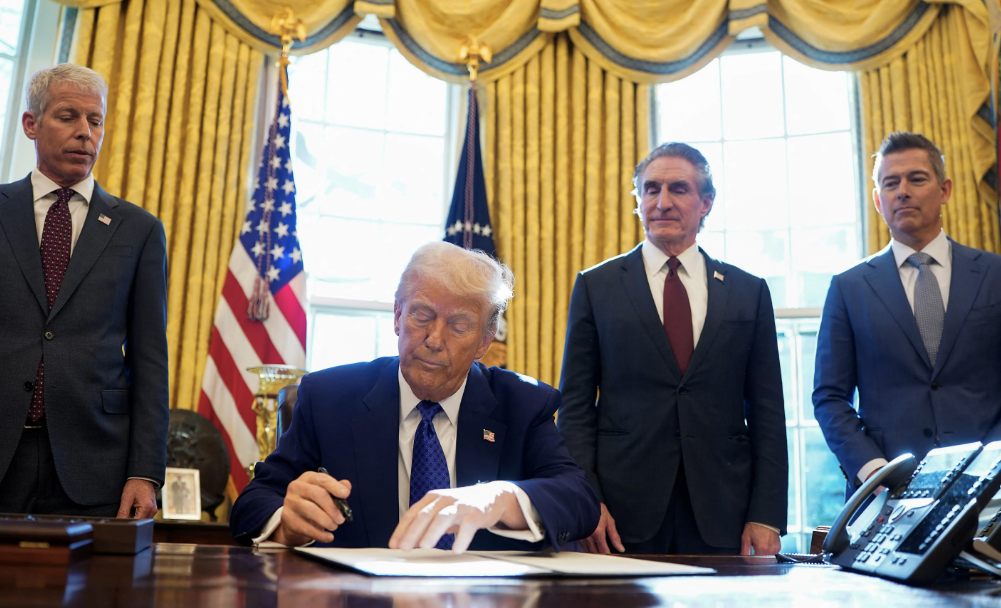
Much of the legislative groundwork aligns with initiatives launched under former President Donald Trump, who signed executive orders pushing for expedited NRC reviews and an 18-month timeline for licensing new reactors. The bill reflects that urgency, mandating faster federal response times and streamlined procedures.
Trump’s vision includes deploying three experimental reactors by July 4, 2026—a symbolic target designed to showcase American energy independence.
Competing with China, Securing the Fuel Supply
Once a global leader in nuclear development, the U.S. has ceded ground to China, which is rapidly building reactors at home and abroad. To reassert leadership, the legislation invokes the Defense Production Act to boost domestic uranium enrichment and reduce dependency on Russian nuclear fuel.
Restarts, Military Bases, and Strategic Sites
The plan also directs federal agencies to explore restarting shuttered nuclear plants and building new reactors on military bases and public lands—moves aimed at accelerating deployment and leveraging existing infrastructure.
Reorganizing the NRC
The bill includes a directive to restructure the NRC, calling its current staffing and processes “misaligned” with congressional intent. The goal: maintain safety while eliminating bureaucratic delays that stall innovation.
An alternative pathway is also introduced, allowing the Energy Secretary to greenlight certain advanced reactor designs—though critics warn this could sidestep the NRC’s safety oversight.
A Race Against the Clock
While the NRC is currently reviewing proposals for next-gen microreactors, the agency expects evaluations to take up to three years—well beyond the 18-month target set by Trump’s orders. Whether the industry and regulators can meet these aggressive deadlines remains an open question.
Federal Incentives and a Deadline
To help projects pencil out financially, the bill preserves tax credits for new and existing nuclear facilities—but only for those that begin construction before January 1, 2029. This deadline creates pressure for shovel-ready projects to move forward quickly.
Aiming for 400 Gigawatts by 2050
The most ambitious goal: quadruple U.S. nuclear generation capacity from 100 gigawatts to 400 gigawatts by mid-century. Achieving this would require massive investment in supply chains, workforce training, and public-private collaboration—comparable in scale to the space race or interstate highway system.
A Historic Fork in the Road
This legislative breakthrough presents a rare window of opportunity to revive America’s nuclear sector. With broad bipartisan support, industry enthusiasm, and growing environmental acceptance, the stage is set for a nuclear resurgence.
But the stakes are high. If regulatory reforms and deployment timelines fall short, the U.S. risks missing its moment—while competitors like China continue to surge ahead.
Success would mean reclaiming global leadership in clean energy technology. Failure could delay meaningful nuclear progress for another generation.