
It was supposed to be just another milestone photo, the kind parents instinctively upload to social media before watching their children cross the threshold into adulthood. But when Nina Green hit “post” in the summer of 2022, she wasn’t just sharing a snapshot of her 16-year-old son, Korben White, heading to his high school prom. She was inadvertently lighting the fuse on a global cultural conversation.
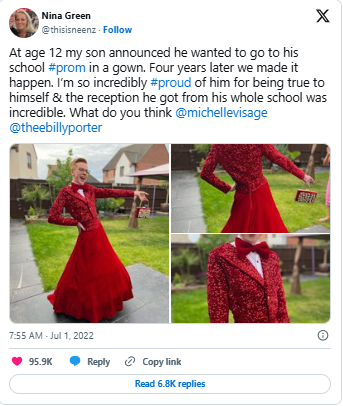
What the world saw was an uncompromising vision in crimson. Arriving at Archbishop Sancroft High School in Harleston, Norfolk, Korben didn’t just make an entrance; he staged a debut. His outfit was a masterclass in sartorial juxtaposition: a sharply tailored, structured tuxedo jacket up top, seamlessly melting into a dramatic, voluminous red ballgown skirt below. Crowned by a shock of vibrant red hair and carried with an undeniable aura of poise, Korben transformed the mundane gravel of a school parking lot into a high-fashion runway.
For those who have followed the fast-evolving landscape of youth identity, Korben’s choice wasn’t a sudden bid for internet notoriety. According to Green, the blueprint for this moment had been quietly forming in her son’s mind since he was just 12 years old. Over four years, an adolescent whim matured into a deliberate, sophisticated declaration of self-expression, heavily influenced by the avant-garde world of drag aesthetics and expressive fashion.
As a veteran journalist, I’ve covered my share of manufactured media storms, but what makes the story of Korben and Nina resonant is the quiet, fiercely protective maternal philosophy at its core. Green didn’t view her son’s wardrobe through the lens of political activism or digital clout. To her, parenting was simple: fuel the child’s confidence, clear the runway, and let them fly.
When Korben stepped out of his vehicle at the prom, the immediate reaction from peers and faculty wasn’t judgment—it was a crescendo of cheers. In a school environment often stereotyped as a crucible of teenage conformity, the response was overwhelmingly celebratory. For a moment, inside the school gates, the world was small, supportive, and kind.
Then, the internet got hold of it.
The Anatomy of a Viral Flashpoint
Within hours of Green sharing the images online, the algorithm did what it does best: it took a tender family milestone and magnified it onto a global stage. The post became a digital wildfire, racking up thousands of shares, retweets, and comments across multiple continents. It caught the attention of high-profile entertainment and media personalities, whose endorsements acted as rocket fuel, elevating Korben from a local Norfolk teenager to an international symbol of Gen Z defiance.
In the comments sections, society did what it always does when confronted with the disruption of traditional norms—it split down the middle.
On one side, a massive wave of adulation poured in. Parents from across the globe thanked Green for her public display of unconditional love. They shared their own stories of raising children who danced outside the margins of societal expectations, framing the post as a beacon of modern parenting and inclusivity.
On the dark side of the ledger, the backlash was swift. For critical onlookers, Korben’s skirt became a proxy war for broader, anxiety-ridden generational and cultural debates. Commenters weaponized the images to argue over the erosion of traditional values, youth identity, and the boundaries of adolescent expression.
“My goal was never to provoke controversy,” Green would later reflect, refusing to back down in the face of digital scrutiny. “It was simply to celebrate my son’s happiness and confidence.”
For Green, the thesis was simple: when children are allowed to express themselves in safe, validating spaces, their emotional development and self-esteem flourish.
The Aftermath of the Spotlight
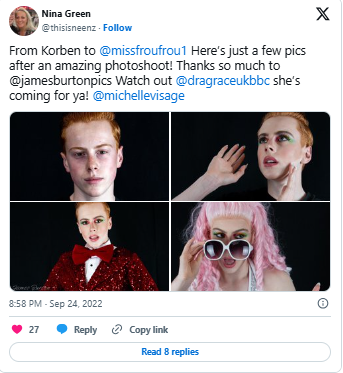
For Korben, the whiplash of going viral was nothing short of surreal. He later noted that the outfit was never intended to be a manifesto or a catalyst for international debate; it was merely an extension of his own creative identity. Yet, his experience serves as a case study in how the digital age aggressively strips context from personal moments, turning private joy into public property.
Ultimately, the enduring legacy of that 2022 prom night isn’t just about a boy in a red dress. It is a mirror held up to a hyper-connected society. It illustrates the duality of modern visibility—how the exact same digital space can offer life-saving validation to a lonely teenager halfway across the world, while simultaneously inviting global condemnation to a family’s doorstep.
Long after the notifications faded and the red skirt was packed away, the narrative remains a powerful testament to the changing tides of youth culture. It proves that while public opinion remains deeply fractured, the armor of unconditional family support is still the greatest shield a child can have when stepping out into an unpredictable world.