The call came while I was standing at the kitchen sink, rinsing out Letty’s cereal bowl and pretending I wasn’t staring at the empty hook by the door. Jonathan’s keys used to hang there. Now, the hook hung empty—more of a monument to his absence than a functional piece of hardware. When the phone rang, the sound sheared through the quiet house, sharp and intrusive. It was the kind of ring that makes the air feel suddenly brittle, as if the walls themselves knew the fragile peace we’d built over the last three months was about to fracture again.
I picked up. The principal’s voice was tight, carrying that specific, heavy cadence I had learned to dread. In the ninety days since Jonathan died, I had learned that nothing good ever arrives in that tone. It is the vocal frequency of consequence.
“Piper?” he said, his voice treading carefully, like a man walking across thin ice.
Before he could draw another breath, I blurted out a question about Letty. When your world collapses, your focus narrows down to a single, desperate point of failure: your child. His response came too quickly, too rehearsed. That speed alone was the giveaway—the universal sign that something was entirely wrong. Then came the words that made the room tilt: there were six men at the school, and they were asking for my daughter by name. My hand slipped against the wet porcelain of the sink. The bowl cracked. For a split second, I couldn’t tell if the sharp, breaking sound had come from the dish or from somewhere deep inside my own chest.
The principal hurried to explain that Letty had refused to leave the front office the moment she heard Jonathan’s name mentioned. That detail hit me harder than the news of the six men. Jonathan wasn’t a static memory to her; he was an active presence, woven into the way she reacted to the world. Grief hadn’t just visited Letty; it had settled into her bones, dynamic and protective. I grabbed my coat by reflex. The house instantly felt too small, too claustrophobic to contain whatever storm was brewing outside, and I knew—with the cold certainty of a widow—that whatever those men wanted, it was tied to a ledger I hadn’t yet learned how to read.
The truth was, the storm had already left its mark on our house the night before.
I had walked into the bathroom to find Letty holding a thick, ribboned bundle of her own hair, sheared off with kitchen scissors. Her small hands were shaking, but her eyes were steady—and that steadiness was far more terrifying than any teenage rebellion would have been. She wasn’t acting out. She was acting forward, executing a decision that was far too heavy for her age, but too entirely sincere to undo.
When I asked her what she was doing, she told me about a girl at school who was losing her hair to cancer treatment. She told me about the cruel, thoughtless laughter that followed that girl through the hallways, and the heavy silence that followed her into the bathroom, where the girl cried alone so no one would see. Letty had watched, listened, and absorbed it all. Then, without a word to anyone, she decided her own hair could become something else in someone else’s life. She didn’t pitch it to me as an act of heroism. To Letty, it was just simple, undeniable logic.
“I just didn’t want her to feel alone,” Letty said softly. “Not the way I know people feel alone.”
That was Jonathan’s voice speaking through our daughter. That was his exact, unyielding worldview—the absolute refusal to let distance justify indifference. I pulled her into my arms before my brain could overcomplicate the moment, because through the pain, a beautiful, devastating realization washed over me: she hadn’t lost him. She had inherited him.
The next morning, we went to Teresa’s salon to repair what raw emotion and kitchen scissors had done. Letty sat beneath the black salon cape like a young soldier preparing for a ceremony, while Teresa muttered a fierce, affectionate sequence of complaints under her breath about impulsive children and reckless bravery. Halfway through the trim, Luis walked into the shop. He stopped dead in his tracks the moment he saw the long braid of hair resting on the counter.
When Luis spoke Jonathan’s name, the atmosphere in the shop shifted instantly, as if the air itself recognized the code.
They began to talk about him in fragments—swapping stories of long work shifts, forgotten jokes, and acts of quiet generosity that nobody had fully tallied up while he was alive. Letty listened to every word, her eyes darting between them, absorbing the anecdotes like she was trying to reconstruct her father from scattered pieces of glass. To her, Jonathan wasn’t an absence to be mourned; he was a pattern she was trying to recognize in the rest of humanity.
By the time the wig was finished, the narrative had already shifted. This wasn’t just about a haircut anymore. It was about recognition—about a child choosing the difficult path of compassion when it would have been infinitely easier to look away. I braced myself, thinking that walking into the school that afternoon would be the hardest part of my week. I was wrong. The hardest part was arriving and realizing that the ripples of Letty’s choice had already outrun us.
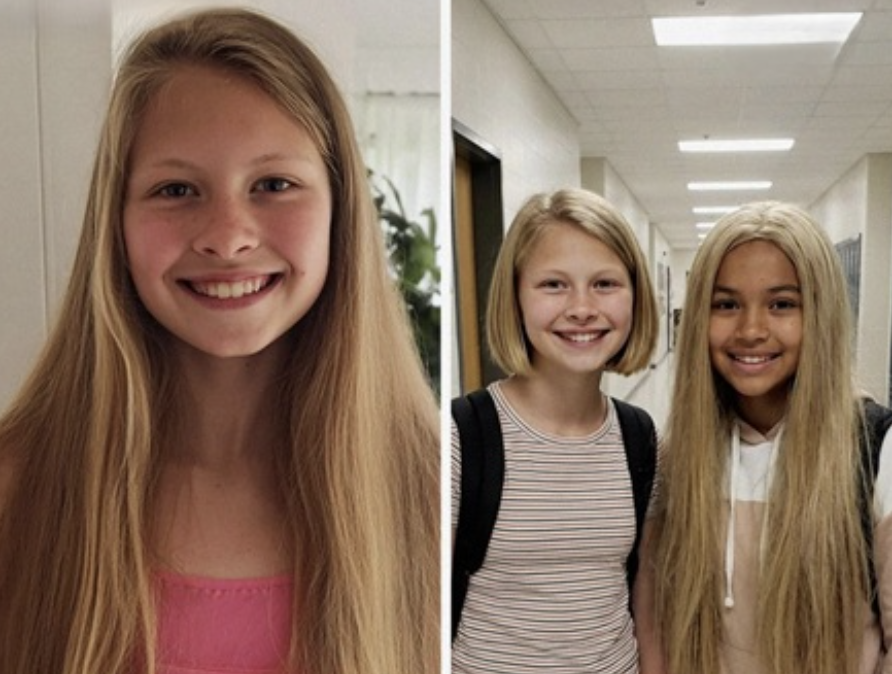
When I finally pushed open the heavy doors to the principal’s office, I found Letty standing next to a young girl I didn’t recognize at first. Then, I saw the wig.
The transformation wasn’t merely cosmetic; it was tectonic. The girl no longer looked like someone being stared at; she looked like someone being seen. Her mother stood in the corner, weeping quietly, while Letty stood squarely beside the girl, as if she had been stationed there by destiny all along.
Then my eyes drifted to the principal’s desk. Resting right in the center was Jonathan’s old, battered hard hat.
I froze. Seeing his name written on the fading plastic pulled open a wound I thought I had successfully cauterized. The principal began to speak, trying to offer an explanation, but the words faded into background noise. It didn’t matter. Not when his memory was sitting in the middle of the room like an uninvited, undeniable guest. Letty turned to look at me, her eyes wide, filled with a dozen questions she didn’t have the vocabulary to ask.
That was when the six men stepped forward from the shadows of the office. They were workers from Jonathan’s old industrial plant, men who carried the literal and figurative weight of a shared, hard-fought history. They didn’t raise their voices. They didn’t need to. Their mere presence altered the gravity of the room. One of them walked to the desk and placed a weathered manila envelope next to the hard hat.
Written across the front, in Jonathan’s unmistakable, blocky handwriting, was my name.
Piper.
The room fell into a silence so profound I can still feel the chill of it today. Marcus, Jonathan’s longtime supervisor, cleared his throat and finally explained the weight of the envelope.
Long before he died—long before any of us knew we would need a miracle—Jonathan had been quietly building something. It wasn’t an official corporate program or a structured non-profit. It was something entirely human, a quiet fund pooled together from overtime pay and spare cash, designed to catch families who were slipping through the cracks of catastrophic medical bills. It existed entirely in the spaces between paychecks, shift changes, and whispered conversations on the factory floor.
They called it the Keep Going Fund.
And somehow, through the chaotic geometry of grief, time, and distance, the momentum of that fund had rolled all the way back to his own front door.
Letty looked from the men to the envelope, trying to map out the impossible reality of how a father who was gone could still be actively reshaping the world around her. Watching her, I finally understood the great journalism of human grief: it isn’t just about the space someone leaves behind. It is about the momentum they leave in their wake. It is about the beautiful, stubborn things that refuse to stop moving even when the hand that spun them has grown cold.
In that crowded office, surrounded by grease-stained men who suddenly felt closer than kin, I finally understood the truth Jonathan had lived by every single day:
People don’t disappear completely. They leave direction behind.