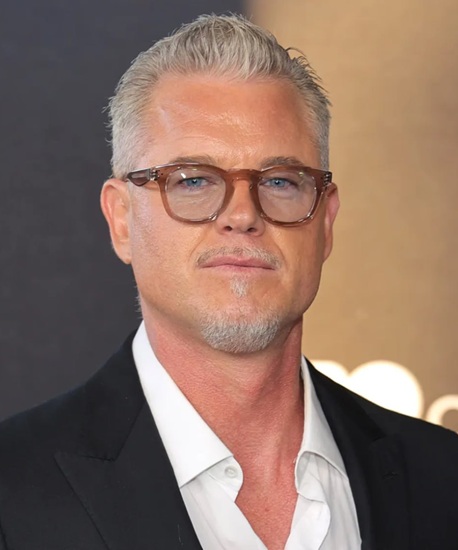
There is a distinct, cruel irony when a disease steals the physical vitality of a man who made his living embodying it.
Eric Dane, the commanding screen presence who swaggered into the American cultural consciousness as Grey’s Anatomy’s “McSteamy” and later captivated audiences as the menacing, fractured patriarch in HBO’s Euphoria, has passed away. He was 53. His death follows a swift, brutal battle with amyotrophic lateral sclerosis (ALS), a diagnosis he faced not with Hollywood melodrama, but with the raw, grounded vulnerability that defined his later years.
According to a statement released by his family, Dane spent his final days exactly where he wanted to be: surrounded by the steady anchor of his life—his wife, Rebecca Gayheart, and their two daughters, Billie and Georgia. In a world of fleeting Hollywood glitz, his family remained his true north until the end.
The Reality of the Diagnosis
To understand the weight of Dane’s final chapter, one must understand the beast he was fighting. ALS, famously known as Lou Gehrig’s disease, is a ruthless, progressive neurodegenerative disorder. It systematically attacks the nerve cells in the brain and spinal cord, cutting off the lines of communication to the muscles. What begins as a subtle tremor or a stumble inevitably marches toward the loss of movement, speech, and eventually, the very breath that sustains life.
Dane, ever the straight shooter, didn’t hide behind public relations shields when the diagnosis arrived earlier this year. Instead, he chose to pull back the curtain. In a series of candid interviews, he charted the terrifying velocity of the disease. He spoke openly about the emotional whiplash of watching his own body rebel, sharing that he had initially lost the strength in his right arm.
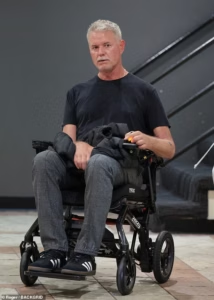
The man who once commanded every room he walked into soon found himself navigating the daily reality of a wheelchair as his mobility faded. Yet, his reflections were entirely devoid of self-pity. He described the illness not as an abstract tragedy, but as a daily, exhausting reality he had to look in the eye every single morning.
From San Francisco to Shondaland
Dane’s journey to the upper echelons of television was fueled by grit. Born in San Francisco in 1972, he was a high school athlete who stumbled into an acting passion during a teenage theater production. With little more than a dream and a nearly empty bank account, he packed his bags for Los Angeles.
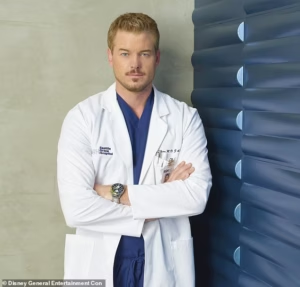
The early years were a familiar Hollywood grind—gigs on episodic television, small parts, and steady hustle. But in 2005, destiny called in the form of a guest spot on a burgeoning medical drama called Grey’s Anatomy.
As Dr. Mark Sloan, Dane didn’t just walk onto the screen; he hijacked it. Emerging from a bathroom in nothing but a strategically placed towel, he became an overnight sensation. What was meant to be a brief stint turned into a defining, multi-season run. Dane infused the cocky plastic surgeon with an unexpected depth, turning a potential caricature into one of the most beloved figures in modern television history.
When he eventually departed the halls of Seattle Grace, it was amidst a turbulent period marked by production shifts and a very public battle with addiction. Where other actors might have spun a narrative or retreated into hiding, Dane was unflinchingly honest about his demons, a trait that earned him deep respect among his peers.
A Second Act in the Shadows
If Grey’s Anatomy made him a star, Euphoria proved he was a heavyweight. In 2019, Dane underwent a profound artistic metamorphosis, taking on the role of Cal Jacobs. It was a staggering performance—a portrait of a man suffocated by repressed trauma, living a double life, and failing his family.
It was a risky, dark, and deeply layered role that introduced Dane to an entirely new generation of viewers. It proved, beyond a shadow of a doubt, that he was far more than the handsome archetype of his thirties; he was a character actor of immense, bruising power. Even as his health began to fail him, his commitment to the craft never wavered. Before his passing, he had expressed a fierce desire to return for the final season of the HBO drama, fighting to work for as long as his body would allow.
Beyond his television triumphs, Dane maintained a steady presence on the big screen, popping up in crowd-pleasers like Marley & Me, Valentine’s Day, and most recently, the high-octane Bad Boys: Ride or Die.
A Final Legacy of Vulnerability
The news of his passing has triggered a massive wave of grief across the entertainment industry. Social media has filled with tributes from co-stars, directors, and fans, all echoing a similar sentiment: Eric Dane was a man who kept it real. They remembered not just the brilliant performances, but the honesty with which he lived his life—addiction, aging, illness, and all.
“He was a man who lived in the public eye, marked by both immense success and profound vulnerability,” noted one industry contemporary. “He showed us that it’s okay to be broken, as long as you keep fighting.”
Ultimately, Eric Dane’s legacy will be dual-fold. He will forever occupy a permanent place in television history, having anchored two massive cultural touchstones in completely different eras. But perhaps more importantly, his final months provided a masterclass in human resilience. By shining a spotlight on the realities of ALS, he gave a voice to thousands fighting the same silent battle.
He leaves behind a body of work that will be watched for decades, a family that adored him, and the memory of a man who faced life—and death—with his eyes wide open.