It started with a rapid-fire succession of pings in the dead of night, the unmistakable cadence of a classic Donald Trump social media blitz. But this wasn’t his usual late-night political grievance or a string of text-heavy endorsements. Instead, users scrolling through Truth Social on Monday evening were treated to a surreal, cinematic spectacle: a digital gallery of high-stakes science fiction, futuristic warfare, and extraterrestrial diplomacy, all conjured up by artificial intelligence.
Within a matter of hours, the former president uploaded roughly two dozen AI-generated images. The breakneck speed and sheer volume of the posts immediately set the internet ablaze. This wasn’t just a casual experiment with new technology; it was a carefully curated, albeit deeply bizarre, narrative that had political analysts, tech watchdogs, and UFO enthusiasts scrambling to decode its meaning.
The images themselves played out like storyboard panels from a big-budget Hollywood blockbuster, blending raw political symbolism with speculative fiction.
From Alien Diplomacy to Cosmic Warfare
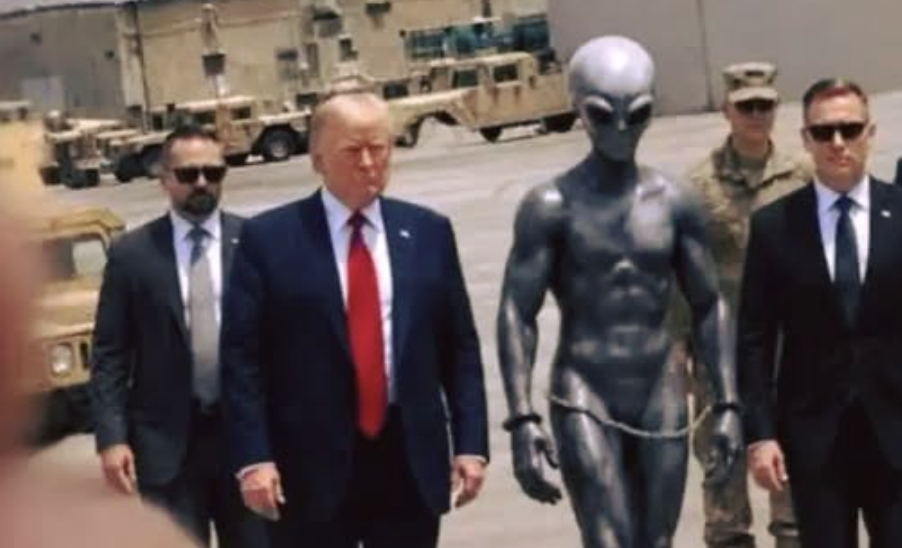
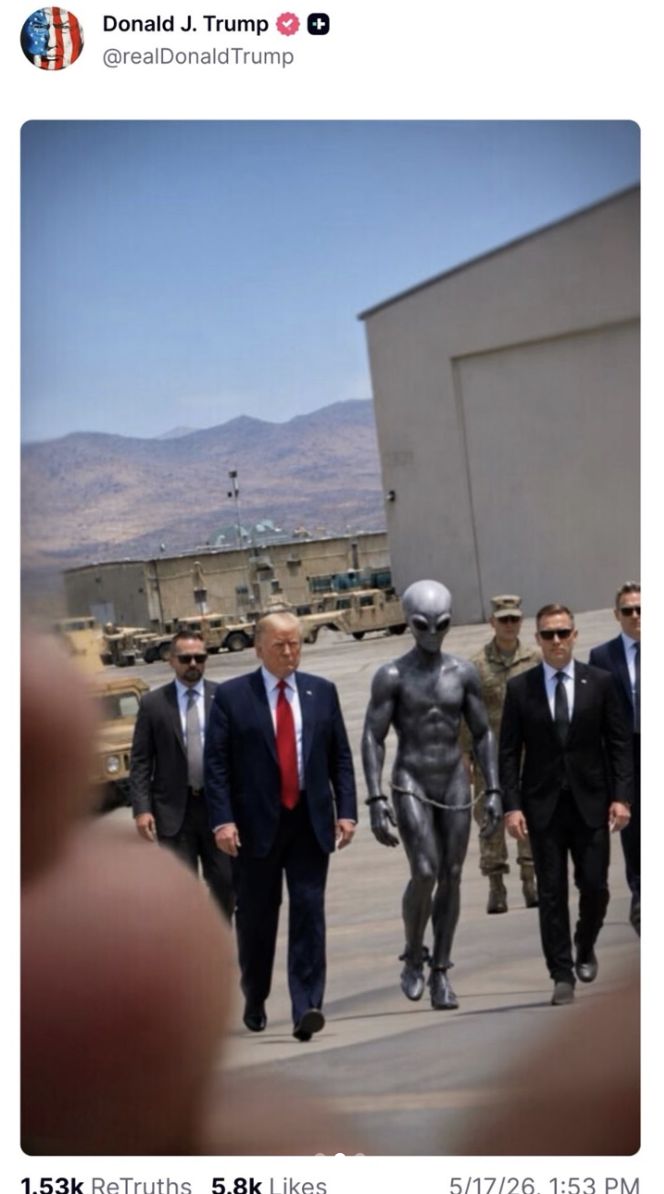
Among the most heavily analyzed images was a stylized, grainy shot that looked less like digital art and more like a leaked government photograph. It depicted Trump walking shoulder-to-shoulder with a classic, Hollywood-style alien figure. Shadowing the duo was a detail of suited men resembling Secret Service agents, maintaining their standard protective formation around the intergalactic VIP. The deliberate, artificial grit of the image sparked immediate debate over whether it was meant to evoke a sense of declassified secrecy.
In another dramatic visual labeled “Space Force,” the former president was depicted floating in low Earth orbit. Surrounded by a halo of advanced satellites, Trump appeared to be orchestrating a massive, planetary military campaign. Screens floating in front of him flickered with exaggerated depictions of warfare: missile trajectories arching across continents, orbital explosions, and simulated large-scale destruction on the surface below.
The third major piece of the digital collection leaned heavily into raw political theater. It portrayed Trump seated before a massive, ominous red button. Surrounding him was a cohort of military officials, but with a strange, surreal twist: the figures were rendered at a fraction of Trump’s physical scale. The resulting composition framed the former president as a towering, singular decision-maker, dwarfing the very institutional power structure meant to advise him.
The Transparency Context: A Calculated Timing?
As the imagery went viral, online communities split down predictable fault lines, but the conversation quickly collided with a genuine, real-world development in Washington.
Just days prior, the Pentagon had initiated a highly publicized rollout of newly declassified materials concerning Unidentified Aerial Phenomena (UAPs)—the modern, institutional term for UFOs. These document drops are part of an ongoing, bipartisan push by Congress to force greater transparency regarding unexplained sightings reported by military pilots and intelligence officials.
“The department is working in lockstep with the administration to provide greater clarity on what the government knows about unidentified anomalous phenomena,” stated Secretary of War Pete Hegseth in recent media briefings. He noted that years of classified secrecy had inadvertently fueled wild public speculation, and that the current initiative was designed to establish a baseline of open, scientific record-keeping.
For a segment of Trump’s base and independent UFO researchers, the timing of the Truth Social posts was an intentional nod to this new era of disclosure. They argued the images were a symbolic commentary on the government finally pulling back the curtain on cosmic secrets.
Weaponized Distraction or Just Digital Play?
Conversely, seasoned political strategists and critics viewed the sci-fi blitz through a much more cynical lens. To them, the sudden influx of alien counter-narratives looked like a classic textbook maneuver: weaponized distraction. On platforms like X (formerly Twitter), users pointed out that the dramatic imagery successfully hijacked the news cycle, effectively burying conversations regarding more grounded, inconvenient political controversies and unfolding international crises.
“Classic redirection,” wrote one widely cited user on X. “When the news on Earth gets too loud, you change the channel to outer space.”
Yet, a third camp of digital media analysts urged caution against over-interpreting the midnight drop. They pointed out that AI-generative tools have become a permanent, highly accessible fixture of modern political communication. In an attention economy, a striking, bizarre, or humorous visual is often deployed simply because it drives engagement, generates memes, and keeps a candidate at the center of the cultural conversation—without needing any deeper geopolitical or cosmic subtext.
The New Frontier of Political Imagery
As of Tuesday morning, representatives for the former president have issued no official statement clarifying the intent, origin, or message behind the digital art gallery. The posts remain active, accumulating millions of views, shares, and deeply polarized interpretations.
Ultimately, the incident serves as a stark case study for the current information ecosystem. We have officially entered an era where AI-generated media, official military transparency initiatives, and hyper-partisan online speculation can collide in a single evening. Whether Trump’s sci-fi gallery was intended as satire, a pointed political metaphor, or a calculated media smoke screen, it underscores a new reality: the tools of artificial intelligence are no longer just tech novelties—they are actively reshaping the theater of political warfare.