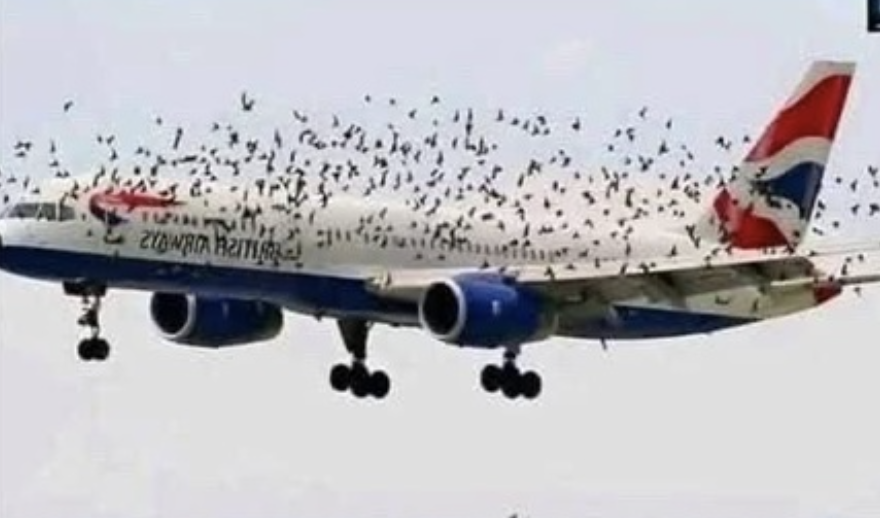
Captain Jason Vance had spent the better part of his adult life measuring reality in knots, altitudes, and the predictable arc of jet streams. With tens of thousands of flight hours logged across every imaginable time zone, weather system, and volatile air corridor on the planet, flying had long since ceased to be a mere profession. It had evolved into a deeply ingrained instinct—a quiet, meditative confidence built upon decades of rigid checklists and muscle memory.
On this particular afternoon, the cockpit of the commercial airliner felt like any other day at the office. The air was unusually calm, the instruments hummed their familiar, reassuring melodies, and visibility stretched out to a crisp, endless horizon.
Beneath the belly of the aircraft, the world was a sprawling canvas suspended in a rich, golden twilight. The sun was lazy in its descent, casting long, amber shadows across the landscape far below.
Inside the main cabin, the atmosphere was a textbook study in mundane travel. Some passengers were lost in the pages of paperbacks; others drifted to sleep with noise-canceling headphones tightly pressed to their ears. A few children stared listlessly out the oval windows at the glowing, cotton-like clouds drifting past. There was no tension, no collective anxiety, and absolutely no warning that their afternoon was about to deviate from the script.
Up front, Vance and his first officer moved through their pre-descent protocols with the synchronized precision of seasoned conductors. Every switch flicked, every minor altitude correction made, and every digital readout confirmed that they were on track for what promised to be one of the smoothest, most unremarkable landings of the month.
The Anomaly on the Horizon
It began as a mere pinprick against the blinding glare of the horizon—an almost imperceptible speck of dust floating in the distance. To an untrained eye, it would have been invisible. But Vance’s eyes were conditioned to scan the sky for anomalies. At their current speed and altitude, even the smallest variance in the forward airspace demanded attention.
As the distance closed, the speck materialized into the unmistakable shape of a large bird. It was unusual to encounter wildlife at this particular height, but certainly not unprecedented. Bird strikes are a known, calculated hazard in modern aviation, though standard operating procedures and natural avian survival instincts typically ensure that paths rarely cross so violently.
Yet, as the seconds ticked away, a cold knot of unease began to form in Vance’s stomach. Something about this encounter felt entirely wrong.
Instead of veering away in a desperate bid for survival, the bird held its line. It remained locked onto the aircraft’s forward trajectory with an unnatural, defiant persistence that defied wildlife biology. Hoping to avoid a messy, unnecessary collision, Vance executed a subtle, practiced adjustment—nudging the massive aircraft slightly off-course and altering their altitude just enough to give the creature wide berth. For a fleeting second, the maneuver seemed to work.
Then, another silhouette appeared out of the glare. Then three more. Then a dozen.
Within a matter of heartbeats, the serene, empty sky around the aircraft dissolved into chaos.
[FLIGHT PATH ANOMALY]
- Initial contact: Single unidentified avian tracking aircraft trajectory.
- Escalation: Multiple formations converging from secondary quadrants.
- Behavior: Structured, non-random, non-migratory convergence.
More birds emerged from the blind spots, rising from multiple directions in a highly coordinated, geometric pattern that completely shattered any notion of random migratory behavior. They weren’t scattering in panic from the roar of the jet engines; they were converging on them. What had started as an isolated incident had rapidly escalated into a deliberate, suffocating structure of feathers and wings closing in on the aircraft’s path.
Vance traded a sharp, silent glance with his co-pilot. In the cockpit of a commercial airliner, silence is often the first line of defense. Experienced aviators don’t waste breath on panic; they use those quiet seconds to process reality when reality stops making sense. The situation unfolding outside their windshield was mutating into something neither man had ever read about in a flight manual, let alone experienced in the air.
As they pushed forward with their descent, the sheer scale of the phenomenon grew overwhelming. Far below, near the ragged edges of the sprawling city suburbs, entire flocks began to erupt from the treelines and open fields like plumes of dark smoke. The sky ahead was rapidly losing its golden hue, darkening not from an approaching weather system or a sudden storm front, but from the sheer density of living tissue. Thousands of birds, rising in undulating, layered formations, were aggressively occupying the very airspace the plane needed to survive.
The visual impact was staggering. The crew was no longer navigating through standard atmosphere; they were steering a multi-ton piece of complex machinery directly into a living, shifting cloud of biological motion.
Impact
The collision was instantaneous and brutal.
A violent, metallic jolt shuddered through the entire frame of the aircraft as a cluster of the larger birds slammed directly into the portside engine. The sound inside the cockpit was an explosive, sickening thud. Instantly, the master caution lights erupted into a sea of flashing red and amber across the instrument panels. A heavy, rhythmic vibration began to rattle the floorboards as engine performance metrics plunged off a cliff.
Warning: Engine 1 Compressor Stall // Thrust Asymmetry Detected
Instinct and decades of rigorous simulator training immediately took the wheel. Vance’s hands were steady as he fought to stabilize the aircraft, working to counteract the sudden, violent asymmetry in thrust while trying to maintain whatever altitude they had left.
But the mathematical reality of their situation was turning grim. One engine was heavily compromised and spewing heat; the aerodynamic drag was worsening by the second, and the surrounding flock showed no signs of dispersing. They remained unrelenting, persistent, and terrifyingly close to the remaining glass and metal of the airframe.
Behind the cockpit door, the fragile illusion of a routine flight shattered in an instant. The calm atmosphere of the passenger cabin collapsed into a wave of raw panic. Oxygen masks dropped from the ceiling panels with a sharp clatter. Flight attendants, fighting the steep tilt of the floor and their own rising adrenaline, moved swiftly through the aisles to ensure passengers were buckled and secure. Men and women clutched their armrests with white-knuckled grips, exchanging terrified glances as the plane began a descent that was far steeper and faster than anyone had anticipated.
Vance’s eyes darted across the digital terrain maps and out through the cockpit glass, frantically scanning the topography below.
Going to a primary or secondary airport was officially out of the question. The mathematical equations of distance, catastrophic engine degradation, and the ongoing interference of the flock made trying to reach a major runway a suicidal gamble.
Then, peering through the chaotic haze of feathers and the sheer cognitive stress of the moment, Vance spotted a thin, pale scratch on the earth near a remote, isolated lake. It was an unmarked, unpaved airstrip—short, rough, and barely long enough to accommodate a plane of this size.
It was their only shot.
“We are committing to the strip by the lake. Configure for emergency landing.”
Vance adjusted their descent trajectory, walking a razor-thin line between maintaining enough speed to prevent a stall and keeping the aircraft slow enough to survive a crash landing on raw earth. The descent became sharper, more aggressive, yet meticulously controlled. The birds followed them down, though their tight formations began to fracture and scatter as they hit the turbulent, chaotic airflow of the lower altitudes.
As the ground rushed up to meet them, Vance focused entirely on the physics of the aircraft. Every single micro-movement of the control yoke mattered now. The landing gear dropped and locked with a heavy, reassuring thud. The makeshift runway aligned through the wind-shield.
[TOUCHDOWN MEMO]
- Location: Unmarked lakeside strip
- Surface: Gravel/Dirt
- Aircraft Status: Single-engine operation, structural vibration
The impact was a violent shock to the system. Tires screamed in protest as they slammed into loose gravel and hard-packed dirt. The aircraft bounced heavily once, then twice, the structural metal groaning under the immense stress before the nose wheel finally came down and held. Vance stood on the brakes, fighting the rudder to keep the sliding fuselage from veering into the trees.
The plane slowed just in time, groaning to a definitive, shuddering halt only a few feet from the lapping edge of the deep water.
The Weight of the Cargo
For a long moment, the world fell absolutely, completely still.
Inside the passenger cabin, the suffocating silence finally broke, giving way to an overwhelming wave of collective relief. Some people wept quietly into their hands; others laughed in sheer, manic disbelief. Many simply sat frozen in their seats, staring blankly ahead as their brains struggled to process the fact that they were still breathing. Against all mathematical probability, against all conventional aviation expectations, they had survived.
But outside the safety of the aluminum hull, the emergency was far from over.
The birds had not gone away.
Instead of scattering into the surrounding wilderness after the crash, the flock began to settle heavily around the stationary aircraft. Thousands of them descended in dense, organized formations, completely blanketing the wings, swarming over the dead engines, and covering every square inch of the surrounding ground. Their behavior was no longer a chaotic frenzy; it was focused. It was intentional. It possessed a protective, almost militaristic structure that was undeniably persistent.
Vance stood at the cockpit window, looking out at the sea of feathers with a growing sense of profound unease. This was not the natural behavior of wildlife scattering after a traumatic impact. Something was holding their attention with an magnetic, unbreakable pull.
Leaving his first officer to coordinate with the cabin crew and manage the post-landing emergency checklists, Vance made a quiet decision. He needed to understand what he was looking at. If the plane remained completely surrounded by this living wall, any attempt at evacuation or rescue would be delayed, dangerous, or outright impossible.
He opened the cockpit door, bypassed the stunned silence of the main cabin, and descended the narrow ladder into the belly of the aircraft: the cargo hold.
The lower compartment was dim, lit only by the low-voltage emergency lighting, and lined with rows of standard luggage and heavy freight containers. The noise from the outside world was muffled here, yet it was incredibly constant—a rhythmic, deafening chorus of thousands of wingbeats and sharp talons scratching against the outer metal fuselage. As Vance walked deeper into the belly of the plane, he realized the sound was changing, growing infinitely more intense toward the very back of the cargo bay.
There, wedged deeply between two mundane commercial shipping crates, sat a sealed wooden container. It did not bear the standard airline bar codes, tracking stickers, or international transport markings. Unlike the rest of the commercial freight, this specific crate had been heavily reinforced with aftermarket steel bands and secured with heavy, specialized locking mechanisms.
Every professional instinct Vance possessed told him that something about this box was wrong.
Using an emergency crowbar clipped to the bulkhead, he worked the steel bands loose and pried open the heavy wooden lid.
Inside, nestled within carefully padded, climate-controlled compartments, lay dozens of delicate, oversized eggs. They were strikingly beautiful, covered in rare, iridescent patterns that looked entirely alien—the unmistakable markings of an incredibly rare, highly protected exotic bird species.
[UNREGISTERED CARGO MANIFEST]
- Contents: Protected exotic avian ova (eggs)
- Status: Contraband / Illicit transport
- Environment: Climate-controlled, reinforced enclosure
The sight of the hidden cargo instantly reframed everything that had happened over the last thirty minutes. This was not a bizarre wildlife anomaly. This was not a freak accident of nature or a random statistical occurrence in the sky.
This was a recovery mission.
Vance’s entire understanding of the crisis shifted as the pieces of the puzzle fell into place with a sickening thud. The thousands of birds outside weren’t attacking the aircraft out of territorial aggression or mindless, animalistic fury—they were responding to a profound loss. What he had classified as an unprovoked threat from his seat in the cockpit was, in reality, a desperate, cross-continental act of rescue.
The aircraft had never been targeted as a mechanical enemy to be destroyed.
It was simply a giant container being followed home.
Outside, the great flock continued to circle and settle, their synchronized movements humming in perfect harmony, reacting to biological signals that operated far beyond the limits of human perception. Inside the dark, cramped cargo hold, Vance stood completely still, the sheer moral weight of what he had discovered settling heavily on his shoulders.
This was no longer an aviation emergency to be reported to the federal authorities.
It was a violent collision between fragile human systems and the unbreakable power of natural instinct—a direct confrontation between corporate concealment and ecological consequence.
And in that quiet, dim space beneath the feet of his oblivious passengers, the veteran captain finally understood something profound: not all emergencies can be solved by a pilot fixing a mechanical failure. Some emergencies are moral, some are ecological, and some are entirely irreversible the moment they leave the ground.