The pre-dawn hours usually offer a deceptive sanctuary. In the stillness between 3:00 a.m. and 5:00 a.m., the city’s pulse slows to a crawl, and for most, the four walls of a bedroom represent the ultimate fortress of safety. But for a man named Julián, that fragility was shattered in a single night, transforming his modest apartment from a place of rest into the site of a life-altering medical emergency.
Julián is the quintessential “everyman”—the kind of neighbor you barely notice because he is so consistently dependable. A hardworking professional who navigates life with a quiet, uncomplaining resilience, he had spent the last four years carving out a solitary but functional existence following a separation from his wife. His apartment was his harbor: unpretentious, familiar, and, until recently, seemingly secure.
However, like many who live alone and balance a demanding career, Julián had allowed his domestic routine to become a series of shortcuts. Cleaning was a weekend chore, often deferred. A window left cracked to catch a breeze, a stray crumb on a nightstand, or a basket of unfolded laundry were dismissed as the harmless clutter of a busy life.
On this particular night, exhaustion won out. Julián retreated to bed, oblivious to the faint, rhythmic buzzing near the glass or the reality that his warm, stagnant indoor environment had become an invitation to the natural world outside.
The Midnight Awakening
The transition from deep sleep to terror was instantaneous.
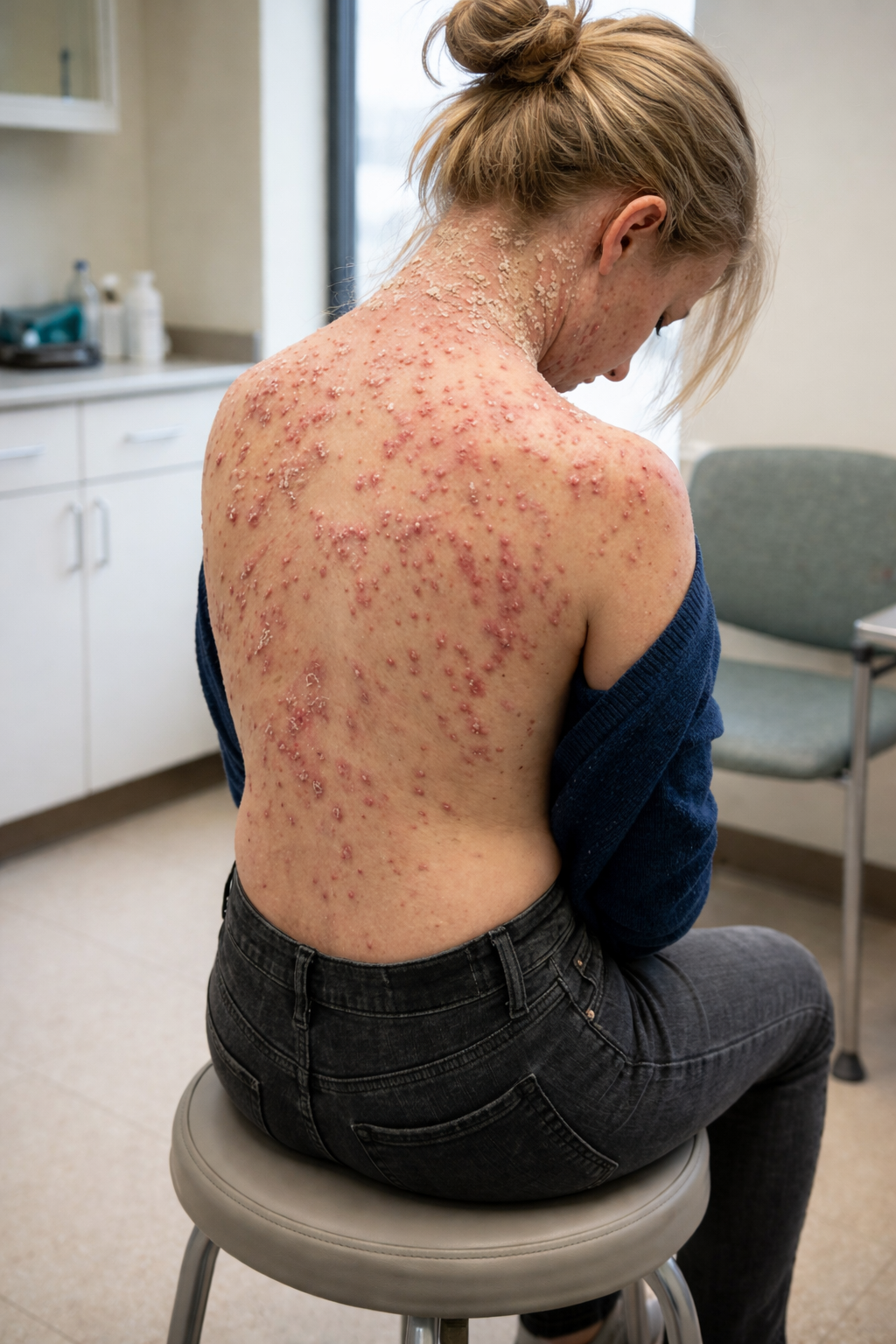
Julián was jolted awake by a searing, localized discomfort radiating across his back. In the fog of sudden arousal, he initially grasped for a rational explanation—perhaps a muscle cramp or a pinched nerve from an awkward position. But as the sensation sharpened into an aggressive, pulsing heat, the “rational” gave way to the visceral.
Attempting to sit up, his heart hammering against his ribs, Julián caught a glimpse of movement in the shadows. Small, dark shapes scurried across the sheets, retreating from the light of his movement. The realization hit with the force of a physical blow: his bed had been compromised. Insects had found him.
What followed was a cascading failure of the body’s equilibrium. As panic set in, Julián’s coordination faltered. He tried to brush his skin clean, but his movements were frantic and ineffective. His breathing became shallow; his vision began to tunnel. This was no longer just a physical encounter with pests; it was a systemic stress response.
Living alone, Julián faced the nightmare of the isolated: he was his own only hope. As his strength ebbed, he managed to lunge for his phone, using the wall to steady a world that was rapidly tilting. He placed a desperate call for help before collapsing, unconscious, onto the floor.
A Critical Intervention
When paramedics breached the apartment, they found a man in the throes of a severe systemic reaction. He was rushed to the emergency room, where a medical team worked to stabilize a patient whose body had essentially declared war on itself.
Hours later, Julián awoke to the sterile hum of a recovery ward. A nurse, part of the team that monitored his recovery, provided the sobering context of his ordeal. He was told that he had suffered an extreme reaction—a perfect storm of multiple insect exposures compounded by an acute physiological stress response.
“The body can respond aggressively to environmental factors we often overlook,” medical staff explained. Certain insects are naturally drawn to warmth and food residue. While a daytime encounter might result in a minor sting or itch, an exposure during sleep—when the body’s defenses are lowered and reaction time is delayed—can escalate into a “life-or-death” scenario.
The Cost of Complacency
The physical wounds of the night eventually closed, but the psychological inventory was just beginning. In the quiet of his recovery, Julián found himself haunted by the “what ifs.” What if he hadn’t reached the phone? What if he had ignored the initial sting and tried to sleep through it?
Medical experts who reviewed the case noted that while Julián’s experience was extreme, it serves as a stark clinical reminder for the general public. For those living alone, environmental maintenance is not just about aesthetics—it is a facet of personal safety. Sealing windows, managing food waste, and the regular inspection of bedding are the primary lines of defense against such “invisible” threats.
A Changed Perspective
Returning to his apartment after being discharged, Julián found that his home felt like a different landscape. The space was identical, but his relationship with it had been fundamentally altered. He spent his first days back performing a deep, meticulous cleaning and repairing the window screens he had long ignored.
The experience stripped away the “illusion of invulnerability” that routine often provides.
“Safety often lies in the details we overlook,” Julián told friends who reached out in shock. His story has since become a cautionary tale within his circle, prompting many to re-evaluate their own home habits.
Today, Julián has resumed his professional life, but the “quiet night” remains a permanent part of his history. He no longer views his evening routine as a mindless series of tasks, but as a deliberate act of self-protection. He treats his rest as something to be guarded, not just taken.
Ultimately, Julián’s ordeal is a testament to the importance of the “early warning system” we all carry—our own physical intuition. It is a reminder that in the face of the ordinary, vigilance is the only thing that separates a routine night from a sudden, life-altering wake-up call.