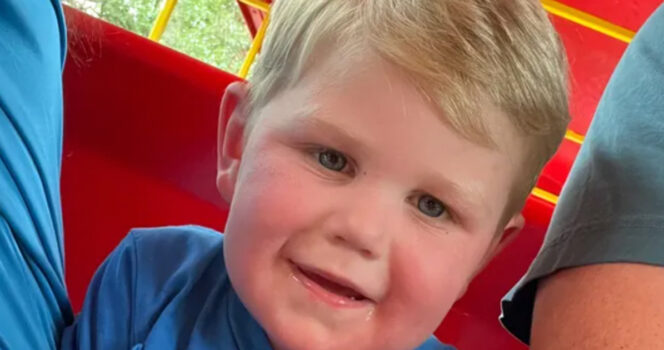
In the golden, humid light of a Georgia afternoon, the line between an idyllic childhood memory and a medical nightmare is often thinner than we care to admit. For two-year-old Beckham Reed, that line vanished in a blur of wings and venom. Beckham, a toddler known for a spirit as vibrant as the Southern sun, is currently entrenched in the fight of his life within the sterile walls of an Intensive Care Unit, the victim of a catastrophic encounter with nature that has left a community reeling and a family clinging to hope.
The Anatomy of a Tragedy: When Play Becomes Perilous
The day began with the familiar sounds of laughter and the whir of plastic tires. Beckham was navigating the yard in his electric toy car, trailing behind his cousins in a scene of quintessential domestic peace. It was a moment of pure, unscripted joy—until the earth seemingly rose up against him.
Unbeknownst to the children, the yard held a hidden subterranean fortress: a yellow jacket nest. When Beckham’s toy car disturbed the colony, it triggered a primal, collective defense mechanism. Unlike honeybees, which die after a single sting, yellow jackets are the infantry of the wasp world—aggressive, territorial, and capable of stinging repeatedly without losing their lives.
In a matter of seconds, the toddler was engulfed in a living cloud of anger. By the time he was rescued, Beckham had been stung more than 150 times. For a fully grown adult, such an onslaught is a traumatic medical event; for a boy of Beckham’s slight stature, it was a biological saturation of toxins that his system was never designed to withstand.
A Hidden Vulnerability: The Medical Crisis Deepens
The initial response at the local emergency room followed the standard protocol for severe envenomation. Doctors worked to manage the immediate agony with morphine and blunt the systemic allergic reaction with Benadryl. For a fleeting moment, it appeared the crisis might be managed. Beckham was stabilized and sent home.
However, the venom—a complex cocktail of peptides and enzymes—was performing a silent, destructive march through his bloodstream. Within 24 hours, the Reed family’s relief turned to pure terror. Beckham’s skin began to take on a telltale yellow hue, a physiological red flag indicating that his internal organs were buckling under the toxic load.
The race back to the hospital revealed a grim reality. Beckham was born with a pre-existing medical hurdle: he has only one functioning kidney. In a body already operating at a renal disadvantage, the sheer volume of yellow jacket venom acted as a sledgehammer. The result was a cascading systemic collapse—multi-organ failure affecting his liver, his heart, and his solitary kidney.
The ICU: A Battle Without an Antidote
Now settled into the Pediatric ICU at Memorial Health in Savannah, Beckham’s survival is a feat of modern mechanical support and raw, toddler-aged resilience. He remains on a ventilator to breathe and undergoes continuous dialysis to perform the work his kidney no longer can.
The medical challenge is exacerbated by a frustrating scientific reality: there is no “antivenom” for yellow jacket stings. In the absence of a silver bullet, the doctors are playing a high-stakes game of “support and wait,” providing the IV medications and technology necessary to keep Beckham alive while his body attempts the Herculean task of filtering out the toxins and regenerating damaged tissue.
“He is STRONG and a great kicker,” his family shared in a poignant update. “We know Beckham is a fighter, and he’s fighting to get better.”
A Community Rallies: The Power of Collective Hope
As the medical team battles the biology of the stings, the Reed family is battling the crushing logistics of a long-term medical crisis. The financial burden of round-the-clock intensive care, dialysis, and specialists is astronomical. In response, a GoFundMe campaign has become a digital sanctuary for those moved by Beckham’s plight.
The response has been a testament to human empathy. From across the globe, donors have poured in support, not just in dollars, but in a shared vigil of prayers and encouragement. This groundswell of support has provided the family with more than just financial relief; it has provided the emotional fuel required to navigate the “slow and delicate” recovery process.
Recent dispatches from the hospital offer the first slivers of light. Beckham’s liver and kidney markers have shown the earliest signs of stabilization. The boy, who spent days lost in a medically induced or venom-clogged haze, is beginning to wake more frequently. While doctors remain “cautiously optimistic,” they emphasize that the road ahead is measured in inches, not miles.
A Warning in the Grass
Beckham’s story serves as a harrowing reminder of the hidden dangers in our own backyards. Yellow jackets are most active during the warmer months, often building nests in wall voids or underground. Their hair-trigger temperament makes them a significant risk to the vulnerable. Experts urge parents to scout play areas for “flight traffic”—bees entering and exiting a single hole in the ground—before letting children roam.
For those looking to assist, the family continues to ask for support through their GoFundMe page and social media updates. In the face of a freak accident that could have happened to any child, the Reeds are choosing to focus on the strength of their son and the kindness of strangers.
The Long Road Home
The journey for Beckham Reed remains shrouded in uncertainty. There are hurdles yet to clear—potential long-term organ damage, the psychological trauma of the event, and the grueling pace of rehabilitation. Yet, if the measure of a recovery is found in the tenacity of the patient, Beckham is well-positioned.
He is a small boy in a very large bed, surrounded by the hum of machines and the whispers of a family that refuses to give up. The venom was powerful, but as the world is learning, Beckham Reed is stronger. For now, Savannah waits, the world watches, and a little boy fights on.