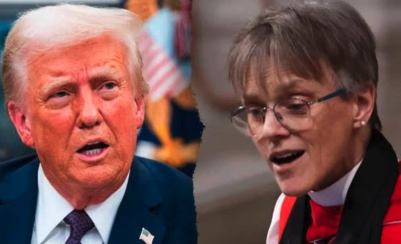
Controversy Erupts as Episcopal Bishop Delivers Partisan Message at Trump Inauguration Prayer Service
At a prayer service held as part of President Donald Trump’s inauguration events, the Right Reverend Mariann Budde, Episcopal Bishop of Washington, sparked intense debate by delivering a sermon that many critics have labeled as politically charged. What was intended to be a moment of spiritual reflection and national unity instead turned into a flashpoint, reigniting longstanding tensions over the role of religious leaders in the political arena.
A Message of Unity — With a Political Edge
Bishop Budde began her sermon by calling on the gathered worshippers to pray for unity amid deep divisions. “We are here to pray for unity as a people and a nation — not for agreement, political or otherwise — but for the kind of unity that fosters community across diversity and division,” she said, setting a tone of reconciliation.
However, the message quickly took on a more pointed and partisan tenor. Addressing President Trump directly, Budde urged him to exercise compassion toward undocumented immigrants and members of the LGBTQ+ community, groups that have often been at the center of political contention under Trump’s administration.
“You have felt the providential hand of a loving God,” she said, “and in the name of our God, I ask you to have mercy upon the people in our country who are scared now.” Budde emphasized the contributions of undocumented immigrants—who she described as hardworking, taxpaying neighbors playing essential roles in sectors like agriculture, healthcare, and food services. She implored the president to consider their dignity and humanity, despite their legal status.
On LGBTQ+ rights, Budde voiced concern over the fear and marginalization many in the community face, urging Trump to protect their safety and uphold their dignity.
Trump’s Swift and Sharp Response
President Trump wasted little time in condemning Budde’s remarks. Returning to the White House, he took to social media to criticize the service as “boring and uninspiring,” labeling the bishop a “radical left hard-line Trump hater.” He accused her of politicizing the pulpit and delivering a sermon that was “nasty in tone” and lacking intelligence or grace.
In defending his own stance, Trump cited examples of crimes committed by undocumented immigrants, using them to reinforce his broader immigration policy positions and reject Budde’s call for compassion.
Broader Political Fallout
The controversy quickly reverberated through political circles. Representative Josh Brecheen (R-OK) notably walked out of the service early, publicly decrying the sermon as an inappropriate injection of partisan politics into a religious ceremony.
“I purposely left the prayer service early after realizing how the pulpit was being used for liberal means and not for true worship unto God and to seek His will and wisdom,” Brecheen explained on social media. “What accosted you today was political, not Biblical.”
The clash between Budde and Trump is not a first. In 2020, the bishop publicly condemned Trump for his photo op outside St. John’s Episcopal Church, where he held up a Bible after law enforcement forcibly cleared protesters nearby. Budde called that moment “outrageous” and denounced what she described as Trump’s “racialized rhetoric.” This latest sermon adds another chapter to their fraught relationship.
The Role of Faith Leaders in Political Discourse
This incident has once again thrust into the spotlight the delicate and often contentious question of the role religious leaders should play in political discussions.
On one side are those who believe faith leaders must maintain strict nonpartisanship, especially during moments designed to unite the nation in prayer. For them, the pulpit should be a refuge from political battles, a place for spiritual reflection and healing rather than divisive rhetoric.
Conversely, many clergy and advocates argue that moral leadership inherently requires confronting social and political injustices. They contend that issues such as immigration and LGBTQ+ rights are not merely political topics but profound ethical concerns rooted in the faith tradition’s calls for compassion, justice, and human dignity.
Supporters of Budde emphasize that her sermon was an act of moral courage—speaking truth to power in a moment when vulnerable communities are at risk. They see her call to the president as consistent with the Episcopal Church’s longstanding commitment to social justice advocacy.
Criticism and Concerns
Opponents, however, argue that Budde’s sermon was inappropriate for the occasion and undermined the prayer service’s purpose. They view the remarks as politicizing a sacred space and deepening national divisions rather than promoting the unity the event purported to foster.
Many conservatives saw Budde’s direct appeals as partisan attacks that unfairly maligned the president and his policies. To them, the sermon crossed a line, turning a unifying moment into a platform for partisan criticism.
Implications for Church-State Relations
This episode illustrates the ongoing tensions inherent in the American tradition of church-state separation combined with a vibrant culture of religious political engagement. The United States has a long history of faith leaders influencing social and political movements, yet questions persist about how clergy should navigate their dual roles as spiritual shepherds and social advocates.
Budde’s sermon and its fallout underscore the risks and rewards for religious figures who engage publicly with politics. On one hand, taking a stand on moral issues can elevate voices that might otherwise be marginalized. On the other, it can provoke backlash and politicize religious institutions in ways that alienate parts of their congregations and broader communities.
Looking Ahead: Challenges and Opportunities
The controversy surrounding Bishop Budde’s sermon highlights the complex landscape religious leaders must navigate today. Increasing political polarization has made it difficult for faith figures to address moral issues without being perceived as partisan actors.
For President Trump and many in his base, Budde’s message reaffirms existing tensions between the administration and certain factions within the religious community. The incident serves as a reminder that even spiritual events are not immune from the political battles shaping the country.
For Budde and those who share her views, the backlash underscores the courage required to speak on behalf of vulnerable populations, especially when doing so risks public criticism and political fallout.
Conclusion
As the nation continues to wrestle with divisive social and political issues, the incident at Trump’s inauguration prayer service is a vivid example of the challenges at the intersection of faith and politics. Bishop Mariann Budde’s sermon provoked a heated debate over the responsibilities of religious leaders in times of national division and the limits of political expression within sacred spaces.
Whether seen as a necessary call for compassion and justice or as an unwelcome intrusion of partisan politics into a spiritual ceremony, the conversation sparked by Budde’s remarks is unlikely to fade soon. The incident raises enduring questions about how faith can contribute to healing a fractured nation — and whether religious leaders can bridge the widening political divides without becoming targets themselves.