But the mood shifted when a brazen theft disrupted the evening. According to police, Noem had placed her $4,400 Louis Vuitton handbag—containing $3,000 in cash, personal ID, DHS badge, and apartment keys—on the floor beside her chair. At around 7:15 p.m., surveillance footage shows a masked individual slipping into the restaurant, using their foot to hook the purse strap, dragging it away under a coat, and exiting unnoticed.
2. A Professional Heist
Noem later described the theft on the Vince podcast:
“I felt what I thought was my grandkids bumping my legs, but it was him hooking the purse. He dragged it away and covered it. It was very professionally done.”
The family quickly alerted staff, who reviewed surveillance footage and contacted police. Within hours, the Secret Service and D.C. Metro Police launched a joint investigation, citing both the security risks and the high-profile nature of the victim.
3. The Key Players: Victim and Suspects
Secretary Kristi Noem—confirmed as DHS Secretary in early 2025 after two terms as South Dakota governor—has been a prominent voice on border security and domestic threats. Her stolen credentials posed immediate national security concerns.
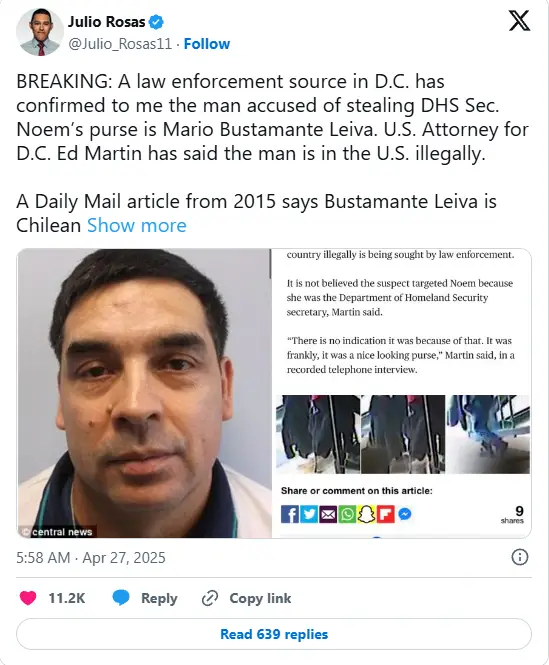
The Suspect(s)—Initial reports identified the alleged thief as Mario Bustamante Leiva, a Chilean national with a previous theft record in the UK. Law enforcement sources say he’s part of an organized crew targeting luxury goods in D.C. A second suspect remains at large, believed to be another undocumented migrant.
4. The Investigation: Fast Action, Major Risks
The Secret Service focused on safeguarding Noem’s credentials, deactivating her DHS badge, and replacing her passport. D.C. police, meanwhile, tracked surveillance footage across nearby blocks. A major lead came from a dashcam that caught a car leaving an alley behind the restaurant.
License plate data led to a nearby apartment complex, where authorities—working with Homeland Security Investigations—recovered Noem’s bag, her documents, and other stolen goods.
5. Organized Theft Rings on the Rise
Authorities say the theft reflects a broader trend: organized crime rings operating with precision in cities like D.C. These groups recruit lookouts, target high-end property, and fence goods through online platforms. The National Retail Federation estimates such thefts cost U.S. businesses $60 billion annually. D.C. businesses near tourist areas have seen theft-related insurance claims spike by up to 20% in recent years.
6. Immigration and Policy Fallout
The alleged immigration status of the suspects has reignited national debate. Supporters of stricter border controls cite the incident as evidence of security gaps. Civil rights groups counter that most undocumented immigrants are law-abiding, warning against the criminalization of entire communities.
Proposed legislation now includes:
Faster data-sharing between ICE and local police for credential-related crimes
Federal grants for business security upgrades
Pilot programs blending enforcement with social outreach
7. Security for Public Officials
The theft has sparked a review of Cabinet-level security protocols—especially regarding secure documents carried during off-duty hours. Recommendations include using less conspicuous bags, limiting exposure of credentials in public, and conducting advance checks at public venues.
8. Legal and Criminal Charges
Prosecutors are expected to pursue felony theft, possession of stolen government property, and possible identity theft. If immigration violations are confirmed, deportation proceedings may follow. Charges could carry prison sentences of up to 10 years under D.C. and federal law.
9. Broader Crime Trends in D.C.
According to MPD’s 2024 data:
Property crimes rose 8%
Grand theft incidents climbed 12%
Organized theft indictments doubled
Analysts cite inflation, gentrification, and housing insecurity as contributing factors. While violent crime has held steady, property crime continues to climb.
10. Looking Ahead: Policy and Prevention
Municipal leaders are weighing responses such as:
Security grants for restaurants and small businesses
“Business Watch” programs modeled after neighborhood watch groups
Coordinated task forces with Secret Service, HSI, ICE, and local police
Urban policy experts stress the need to balance enforcement with trust.
“If residents fear that reporting a crime could trigger immigration action, community safety suffers,” says Dr. Maria Rodriguez, an urban policy analyst.
Conclusion: A Purse Theft, A Wake-Up Call
What began as a family Easter dinner turned into a national security incident. The theft of Secretary Noem’s purse revealed the reach of organized theft rings, the vulnerabilities of even high-ranking officials, and the layered debates around crime, immigration, and urban policy.
The case is still unfolding, but one thing is clear: the risks of modern city life don’t discriminate by title or office. This incident is a reminder that public safety, civil liberties, and smart governance must go hand in hand—especially in the nation’s capital.