A series of high-impact disaster scenarios—from drone disruptions at airports to cyberattacks on financial networks—are not the stuff of Hollywood fiction, but potential real-world threats outlined in two newly released reports by leading U.S. security experts.
The analyses, from Sandor Fabian of the Modern War Institute and Ian Mitch of the RAND Corporation, highlight a sobering possibility: a large, largely undetected network of Chinese operatives already operating inside the United States, capable of triggering chaos if U.S.-China tensions erupt into conflict.
Among the hypothetical but increasingly plausible events the authors warn of:
-
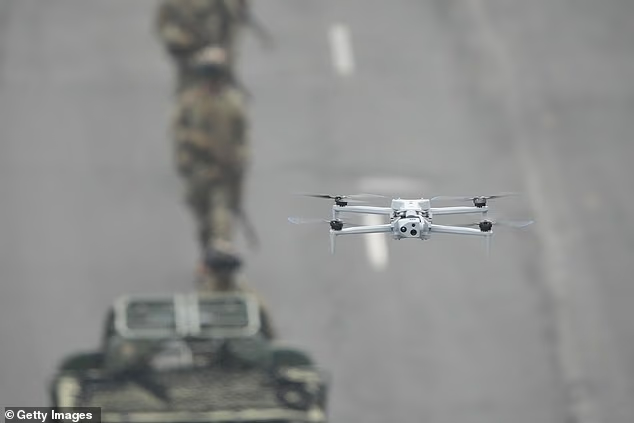
Drones grounding flights at Atlanta’s airport.
-
A power substation fire shutting down parts of Chicago.
-
A contaminated reservoir leaving Denver without water.
-
Mass shootings triggered by online psy-ops.
-
Cyberattacks disabling Wall Street infrastructure.
-
Armed migrants overwhelming the U.S. border at Eagle Pass.
According to Fabian, a former NATO commando, and Mitch, a former Department of Homeland Security analyst, these aren’t far-fetched fantasies, but low-cost, asymmetric tactics that could be deployed from within the U.S.—many of them deniable and non-military in nature.
“The ways available for China to inflict serious physical and psychological damage on the U.S. homeland are only limited by Beijing’s imagination,” Fabian wrote.
The reports suggest China has quietly built a “deep bench” of assets in the U.S., many of them posing as students, researchers, or business professionals. While their primary mission may have been monitoring Chinese dissidents, experts now fear they could be repurposed as saboteurs during a crisis.

Existing Incidents Fuel Concern
These warnings are not without precedent. In June, a Chinese researcher at the University of Michigan, Yunqing Jian, and her boyfriend were charged with attempting to smuggle Fusarium graminearum, a crop-destroying fungus categorized as an agroterrorism agent, into the U.S.
The FBI called the incident a “sobering reminder” of the Chinese Communist Party’s infiltration strategy.
Other known cases include:
-
Wang Shujun, a Chinese-American academic, convicted of pretending to be a pro-democracy activist while feeding information about dissidents to Beijing.
-
Chen Jinping, who pleaded guilty to running an illegal Chinese police station in Manhattan’s Chinatown, used to monitor and intimidate dissidents on U.S. soil.
-
Coordinated physical attacks on anti-Beijing protesters during President Xi Jinping’s visit to San Francisco in 2023, involving flagpoles, chemicals, and sand.
The reports also point to dozens of instances where Chinese nationals—often disguised as tourists—attempted to access U.S. military bases, raising fears of future sabotage or reconnaissance missions.

Infrastructure Vulnerabilities and the Psy-Ops Frontier
Fabian and Mitch warn that critical U.S. infrastructure—including power grids, hospitals, financial systems, and even food supply chains—could be disrupted through a mix of cyberattacks, drone incursions, and psychological manipulation.
Their predictions include:
-
Cyberstrikes on hospitals, banks, and utilities.
-
Weaponized misinformation and deepfakes flooding social media to sow distrust.
-
Mass immigration events engineered to stress border control systems and trigger political flashpoints.
-
Drones used to monitor or disable airspace over key airports.
-
Undersea cable sabotage to disrupt communications.
“We are already a fragmented society,” Mitch noted. “Foreign actors can light the match with psy-ops or bot-fueled disinformation campaigns.”
Despite the FBI devoting around half its 5,000 counterintelligence cases to China as of 2020, the authors argue that the U.S. intelligence community remains overstretched and underprepared for this evolving threat.
Tensions with Beijing Mount
These warnings come amid growing tensions between Washington and Beijing, especially over Taiwan, which China claims as its own. U.S. defense officials have confirmed that Chinese President Xi Jinping has directed military forces to be ready to seize Taiwan by 2027.
The reports suggest China may try to avoid a conventional or nuclear conflict and instead opt for gray-zone tactics, including attacks launched from within the U.S. homeland that Beijing could plausibly deny.
Official Response and Rebuttal
In a statement to the Daily Mail, China’s embassy in Washington dismissed the reports as “groundless and malicious smear attacks.”
“China is committed to peaceful development,” the spokesperson said. “We never pose a threat to any country, nor interfere in other countries’ internal affairs.”
Despite that statement, U.S. lawmakers are taking notice. This week, House Republicans introduced legislation aimed at curbing Chinese ownership of American farmland, citing national security concerns. Chinese entities currently hold more than 265,000 acres—some of it near sensitive military sites.
“A Total Defense Approach”
Fabian argues that the U.S. must adopt a broader national defense strategy—one that doesn’t just rely on military power but includes civic awareness and resilience.
“It’s time to begin preparing American society—not just the military—for the realities of a future conflict,” he said.
For now, the U.S. remains at peace with China. But as both nations continue to navigate a complex relationship filled with economic competition, diplomatic engagement, and military tension, experts warn that the battleground of the future may not be abroad—but here at home.