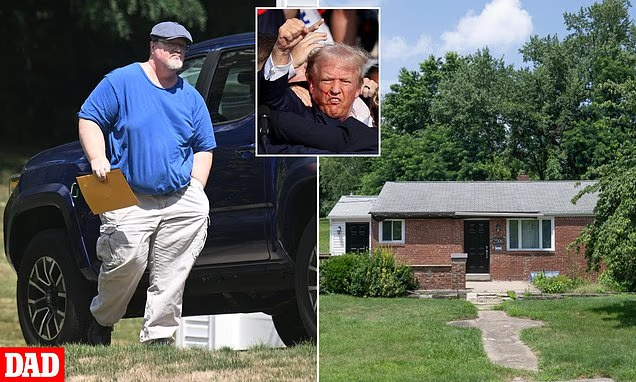
Behind the blackout blinds covering every window and the security cameras aimed at all angles of a modest brick home in Bethel Park, Pennsylvania, live the parents of Thomas Matthew Crooks—the young man who nearly assassinated President Donald Trump on July 13, 2024, at a campaign rally in Butler. His bullet grazed Trump’s ear and killed retired fire chief Corey Comperatore. Yet, one year later, the shooter’s family remains an enigma.
Matthew and Mary Crooks, the parents of the 20-year-old gunman, have not spoken publicly since the day their son carried out the chilling act. When a Daily Mail reporter knocked on their door this week, they remained silent. Their silence has been mirrored by their absence from the neighborhood, leading many locals to assume the family had quietly moved away from the leafy suburb.
Crooks’ 24-year-old sister, Katherine—who works as a janitor—has occasionally been seen leaving her apartment nearby, but her parents have retreated into near-total seclusion. The only clue the house is still occupied is the rare movement of a vehicle in the driveway. One neighbor noted, “We haven’t seen anyone coming or going for quite a while. Most of us thought they had moved on or are still keeping to themselves.”
According to sources, Crooks’ father has resorted to late-night grocery runs—sometimes as late as 3 a.m.—to avoid the public eye. Both he and his wife, who is visually impaired, previously worked as social workers since 2002. But in the wake of their son’s assassination attempt, neither has renewed their professional licenses, which expired in February 2025.
A Motive Still Missing
The family’s silence is just one unresolved part of a larger puzzle. One year later, the FBI has still not determined a clear motive for the attack. Crooks was described by many as a mild-mannered student. He left behind no manifesto, no confession—only digital traces.
In April, just months before the shooting, Crooks had searched online for information about major depressive disorder and crisis treatment. He also looked up details on Michigan mass shooter Ethan Crumbley and his parents, raising concerns that he may have been fixated on other high-profile crimes.
That morning, his parents tried to contact him when they noticed he was missing. When he didn’t respond, they alerted authorities. It’s unclear whether they knew he was armed.
Crooks left home with an AR-15-style rifle—legally purchased by his father in 2013 and transferred to him in 2023. The day before the shooting, he practiced with it at the Clairton Sportsmen’s Club, firing from a range that nearly mirrored the 187-yard distance from which he shot the president.
A Home Arsenal and Explosives
Immediately after the attack, FBI agents swarmed the family’s home, seizing 14 firearms, explosives, a bulletproof vest, and additional ammunition. Investigators also recovered a drone, a second cellphone, a laptop, and a hard drive from Crooks’ car, along with rudimentary explosive devices.
Despite the magnitude of the crime, another mystery lingers: why the FBI allowed Crooks’ body to be released so quickly. He was cremated just 10 days after the shooting, and there’s no plaque or burial site at the Crooks family plot in Mount Royal Cemetery in Glenshaw, where three generations of his relatives are interred.
Crooks was killed 26 seconds after opening fire, neutralized by a Secret Service sniper. But in that half-minute, he had already fired eight rounds—one of which struck Trump and another that killed Comperatore. Two other rally attendees, James Copenhaver, 74, and David Dutch, 57, were critically wounded and left with life-altering injuries.
Secret Service Failures and Fallout
Nearly a year after the attempt on President Trump’s life, the fallout continues for the U.S. Secret Service. Six agents have been suspended for up to 42 days without pay, following an internal investigation that found serious lapses in planning and communication.
Among the suspended was agent Myosoty Perez, who was deployed to the rally site ahead of the event and was responsible for helping to secure the perimeter. Another suspended agent had been involved in security coordination for the rally, while four others were from the Pittsburgh field office. One of the six belonged to the counter-sniper team.
A report issued days before the 2024 election revealed that the Secret Service suffered from “multiple operational and communication gaps” during the rally. These included breakdowns in command, poor radio coordination, and failures in local-federal integration.
Former Secret Service agent Dan Bongino, now Deputy Director of the FBI, called the incident a “catastrophic failure” and demanded sweeping leadership changes within the agency.
The fallout led to the resignation of Director Kimberly Cheatle. Her successor, Matt Quinn, stated the agency is now “laser focused” on systemic reform. Measures taken since include the deployment of military-grade drones, new mobile command posts, and enhanced coordination with local law enforcement—addressing key failures cited in the attack.
A Preventable Tragedy
A 180-page report by a congressional task force, released in December, deemed the shooting “preventable.” It found that Crooks could have been intercepted at several points, including when a local officer spotted him with a rifle and shouted a warning that apparently never reached the presidential security detail.
The report sharply criticized the assumption made by the Secret Service that local law enforcement had fully secured the adjacent AGR building—the very spot from which Crooks fired his shots.
As the investigation lingers, so too do the questions. What exactly drove Thomas Matthew Crooks to target President Trump? What did his family know—and when? And why, amid the rubble of an attempted political assassination, has the silence of the people closest to him been so deafening?