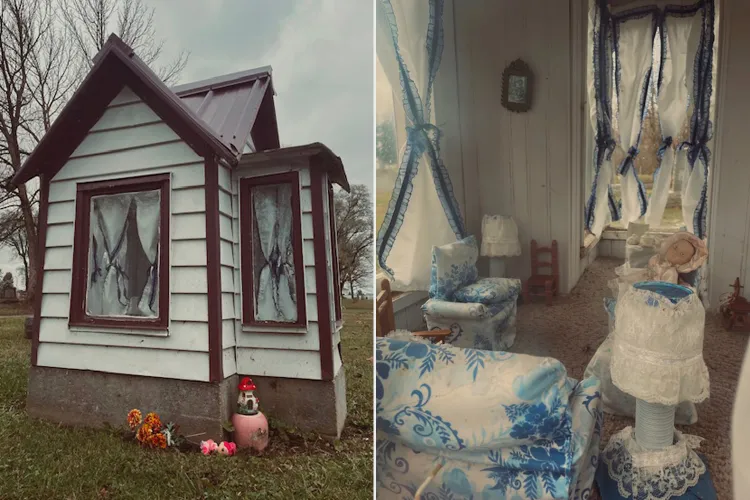
Two families in Indiana chose to honor the short lives of their daughters in an unforgettable, deeply touching way — by transforming their graves into miniature dollhouses that have withstood the test of time and become hauntingly beautiful landmarks of remembrance.
Paranormal investigator and travel blogger Courtney Eastman, known for exploring haunted and historically rich sites across the U.S., visited these extraordinary gravesites in November. What she found in rural Indiana were not just tributes, but powerful expressions of love, grief, and memory.
“I was out there for an investigation weekend,” Eastman told PEOPLE. “Whenever I plan a trip, I look for unique stops along the way. A few of my friends had posted about Lova Cline’s dollhouse, so she was already on my radar. But when I started researching the Indiana State Sanatorium — my main destination — I stumbled upon Vivian’s story.”
The two girls, Vivian May Allison and Lova Cline, were born just a few years apart in the late 1800s and early 1900s. Both tragically died young — Vivian at 5 years old in 1899, and Lova at age 6 in 1908. And in both cases, their parents turned their sorrow into artful memorials, building dollhouse-style tributes on their daughters’ graves — places filled with personal artifacts, mini furniture, and reminders of the childhoods they never got to finish.
Vivian’s father, Horace Dean Allison, had been building her a dollhouse for Christmas. But after her sudden death from spinal meningitis, he completed the dollhouse anyway — with help from her mother, Carrie — and placed it at her burial site, decorating it with the toys and treasures Vivian loved.
Lova Cline’s story echoes Vivian’s. Born with a debilitating neurological condition, Lova found joy in a large dollhouse her father built for her. After her passing, that same dollhouse was relocated to her grave, only 25 miles from Vivian’s, creating an unintentional but poignant symmetry between the two families’ loss and love.
“These aren’t the kinds of graves you just pass by without noticing,” Eastman explained. “They stop you. They invite you in. And they tell stories not only about the children buried there but about the depth of grief and love their parents felt. It’s rare to see mourning expressed in such a creative and enduring way.”
She added, “It felt really special to share these stories with the world, especially because so many people didn’t even know about Vivian’s grave. They’d heard of Lova, but not that there was another like hers so nearby.”
Eastman, who founded The Ghoul Guide, has been fascinated by the paranormal since her childhood in Buffalo, New York. “I was the kid who convinced friends at sleepovers to play Bloody Mary,” she laughed. “During the lockdown, I started exploring local cemeteries just to get outside. Buffalo has a lot of haunted history, and that sparked the idea to start telling these stories on a bigger scale.”
Her social media platform has grown into a vibrant community of like-minded explorers, ghost hunters, and history lovers. She travels across the East Coast and Midwest, not just to investigate and blog, but to host live ghost hunts, sharing equipment and experiences with curious attendees.
“It’s been amazing to see how many people are now open about their interest in the paranormal. What used to be taboo has become something we can all connect over,” Eastman said. “For me, it’s not just about ghosts — it’s about preserving untold stories and giving voices to the forgotten.”
That mission continues with Vivian and Lova. Inside the dollhouses — which have been carefully maintained for over a century — visitors can still see tiny trinkets, faded curtains, and child-sized furniture. They are not just graves. They are time capsules of love.
“People have started telling me about other dollhouse graves across the country — in places like Alaska, Alabama, and Tennessee,” Eastman said. “It’s beautiful to see how this tradition, as unusual as it is, brings people together around shared grief, shared history, and shared humanity.”
But she also urges visitors to treat these spaces with reverence. Over the years, the dollhouses have suffered from vandalism, forcing families and local caretakers to repair them repeatedly.
“If you go, be respectful,” she said. “These are sacred places — not tourist attractions. They represent lives cut short and families who tried to hold on to memory the only way they knew how.”
In remembering these little girls — not just as statistics but as individuals — Eastman hopes to inspire a deeper appreciation for the past and the ways we choose to mourn, memorialize, and move forward.
“They were children who never got to grow up,” she said softly. “But through these dollhouses, their stories live on. And I think that’s something worth honoring.”